Feb
08

Indra Nooyi is leading PepsiCo on a journey. But folks like Barron’s Andrew Barry believe she has chosen the wrong path. He argues in the November 21, 2011 edition that Indra Nooyi is a “potentially vulnerable CEO whose departure probably would be greeted favorably on Wall Street.” Let’s hope he is wrong, suffering like so many of his downtown brethren from a case of short-term thinking.

At the center of the debate lies the following question: Can a large established multi-national corporation change its way of doing business from the quarterly earnings focus to a shared value approach? Or must this approach be built from the ground up, as was the case with Jeffrey Hollender’s (www.jeffreyhollender.com) 7th Generation and John Mackey’s Whole Foods.

The story of 7th Generation is a great one. Even the name selection was purposeful- derived from the Iroquois Indians’ credo to think of your actions in terms of how they will affect your community and the world at large seven generations from now. It is just as admirable to see Indra Nooyi, the CEO of PepsiCo, beginning the journey on behalf of one of the world’s largest and well-established companies.

At Trust Across America (www.trustacrossamerica.com) our model takes a broad cross-silo view of the holistic health of a company, a full body scan of sorts, to determine its trustworthiness. We examine both financial and non-financial drivers of trustworthy business behavior- specifically, financial stability, accounting conservativeness, corporate integrity, transparency and sustainability. So while, for example, environmental sustainability efforts are critically important, they only tell a small portion about the company’s overall well being.

According to our model, PepsiCo has enjoyed relatively strong scores with regards to both “transparency” and “sustainability” for several years. But what currently catches our attention is the significant increase in its “accounting conservativeness” and “corporate governance” scores. This leads us to believe that the company is getting healthier in ways that may not be important to the pervasive short-term thinking on Wall Street.

Yes, Pepsi’s financial metrics appear weaker in our model than they were a year ago. So do Coke’s. But we know that companies starting out on the journey of improvement might not show an immediate increase in shareholder value. According to Dov Seidman, the author of How (www.howsmatter.com) and the head of LRN (www.lrn.com), organizations take non-linear roads through periods of self- improvement. He quotes legendary Hall of Fame basketball coach John Wooden who said, “It isn’t what you do, but how you do it.” While Wooden’s first few years were not exemplary, he went on to build perhaps the strongest and most successful college basketball program in history.

Setting off on a journey, by its very meaning, does not imply a simple straight road to a destination. Even on successful journeys unfruitful trails may be encountered and backtracking is often required. While the short-term thinkers may be focused on splitting PepsiCo up to enhance short-term shareholder value, our guess is that Ms. Nooyi is making strategic decisions based upon longer-term “deeper meaning” Performance with Purpose implications.  She is among a handful of CEO’s that do more than just talk about this somewhat new management approach. Lenny Mendonca of McKinsey echoes these sentiments in a recent video he produced for The Management Exchange. www.managementexchange.com/video/lenny-mendonca-true-accountability-journey-0  Building great companies is no easy journey. We hope Indra Nooyi is allowed to continue down the path she has chosen.

Barbara Brooks Kimmel is the Executive Director of Trust Across America, a program that is setting the “Gold Standard” for trustworthy business behavior.  Let us know what you think about Indra Nooyi’s performance at PepsiCo. Leave your comments here or email Barbara@trustacrossamerica.com


Jan
14

[DISCLAIMER: I am not retained by Frank Sonnenberg or

receiving any compensation for recommending this book.]

Frank Sonnenberg has published four books and over three hundred articles. In 2011, Social Media Marketing Magazine (SMM) selected Sonnenberg as one of the top marketing authors in the world on Twitter (@FSonnenberg, @A_Conscience). In 2012, Trust Across America named him one of America’s Top 100 Thought Leaders in Trustworthy Business Behavior. Industry Week named the first edition of his book, Managing with a Conscience, one of the Top 10 Business Books of the Year. The second edition of Managing with a Conscience: How to Improve Performance Through Integrity, Trust, and Commitment (tinyurl.com/7dv7upj) was released in November 2011.  


KIMMEL: Why is your book a must-read for business leaders?


SONNENBERG: In the dog-eat-dog times of the past few decades, many believed that the only way to achieve success was to be unscrupulous. Acting like slumlords, corporations let their assets deteriorate by exploiting customers, mistreating employees, and squeezing suppliers. What they overlooked, however, was that their obsession with short-term results significantly damaged their company’s long-term performance as well as its competitiveness. Today, it is more critical than ever to put an end to these shortsighted tactics.  


KIMMEL: What is the premise of your book?  


SONNENBERG: In the twentieth century, a company measured success by the number of tangible assets (such as property, plant, and equipment) it posted on its balance sheet. In the Information Age, however, intangible assets rule the day. Soft assets such as trust, innovation, focus, speed, flexibility, relationships, loyalty, employee commitment, and the ability to adapt to change are some of the factors that determine success. Just because these intangibles are difficult to measure and quantify doesn’t mean they’re less important. The truth is, leaders who have a jaded view of intangible assets will never make the commitment required to reap their full potential.


KIMMEL: Can you provide me with concrete examples of how current management practices are hurting the bottom line?  


SONNENBERG: Sure. Sometimes it seems like businesses can’t get out of their own way.


Does the right hand know what the left hand is doing? If you randomly selected 50 employees and asked them basic questions about the heart of your organization, would their answers be similar? For example, ask them: What is our organization’s mission? What are our core values? What factors are most important to our future success? What are our core competencies? How does someone get ahead in our organization? How do we differentiate ourselves from the competition? Unless your employees give similar answers to these most basic questions, waste, redundancies, inefficiencies, confusion, and anxiety are likely; the result—employees working at cross-purposes.


The only thing we have to fear is fear itself.  Just as pollution damages the environment, an air of fear is toxic to companies. When people believe they lack control over what happens to them, they become fearful. And whether their fears are real or imagined or arise over things that are concrete and immediate, such as loss of a job, or things that are more ephemeral and long term, such as personal embarrassment or damage to personal credibility or career mobility, the results are still the same: inaction, withdrawal, hiding mistakes, misrepresenting facts, or procrastination.


Take this wall down. Bloated corporate bureaucracies crush aspirations, stifle creativity, suppress ingenuity, and slow down responsiveness. Unfortunately, once bureaucracy develops, it is as difficult to control in business as crabgrass on a suburban lawn. It causes people to thirst for power, value personal ambition over team gain, and put paperwork before people.   In bureaucracies, people choose the political solution rather than the best answer. Promotions are earned through political savvy rather than performance; the “show” becomes more important than content; and rumor becomes the primary form of communication. This causes organizations to focus inward and lose touch with reality.   Do you want more examples, Barbara? How much time do you have?


KIMMEL: Your book introduces a powerful prescription for business. How do people manage with a conscience?  


SONNENBERG: Good question, Barbara. Here are some examples:  


Talk is cheap. Having integrity means sticking to your principles, no matter what. It means making sure that your actions are consistent with your words. If it’s the last day of the sales month, and the numbers look lousy, are employees still encouraged to do what is in the best interests of the customer or are they asked to sell something for immediate gain? Are managers rewarded for the development of their people as well as for the bottom line? Is a promise made to a customer kept, even though circumstances have changed in such a way that the agreement is now less profitable? The answers to these questions will tell you whether your company values principled behavior over short-term business gain.


People live up or down to your expectations. Companies that search for the best and brightest people must learn that their efforts shouldn’t end when those people join the organization. To retain these employees, companies should invest heavily in them, both personally and professionally. Today, employees demand trust and respect. They want their input solicited, their strengths utilized, and their contributions valued. Furthermore, they want and should be given challenging new responsibilities that stretch their potential. The opposite is also true: Employees who feel like helpless drones perform that way.


Communication isn’t a luxury; it’s a necessity. Management must accept responsibility for fostering an open and honest environment. This requires letting go, unlearning many management practices of the past. But that is not easy, and it does not happen quickly. It requires managers to leave behind many skills, sources of status and power, and implicit assumptions about the workplace. In the past, leaders assumed the role of controlling the information employees needed to make day-to-day decisions. Leaders who continue along that path will become frustrated as they lose the confidence of employees whose desire for timely, customized information is not satisfied. Leaders must view communication as an avenue to release the creative genius of an organization, not as a bothersome chore. After all, communication acts as a powerful agent of change, a source of continuous improvement, and a catalyst for moving the organization forward.


Lifetime customer relationships. Customers must not be viewed as isolated transactions but rather as the potential lifelong relationship that they represent. Every customer deserves to be treated as your organization’s only client. Companies cannot afford to spend the time and effort that it takes to develop new business only to lose customers shortly thereafter. In fact, companies should be so outraged when they lose an existing customer that they immediately search for ways to improve themselves so that it never happens again. Think about the effort of bringing in new customers; the way they are courted; how you accommodate their every whim. Then, when they become customers, the honeymoon ends. Think about your major customers. When they call, everything else is dropped; when they make suggestions, everyone listens; and when they need something done, everyone responds. Now think about all your other customers. We can’t accommodate them because it’s against company policy; we don’t listen to their suggestions because we know better than they do; we can’t take their calls because we’re in meetings; everything that takes a little extra effort is a bother.


KIMMEL: Are you currently doing any other writing?


SONNENBERG: I launched a new blog a little over a year ago: www.franksonnenbergonline.com. My mission is to spur conversation about the urgent need to reawaken personal values and personal responsibility.


KIMMEL: We’ll have to have you back to talk about the new trust model that you introduced in your book.


Thanks, Frank.


Do you have questions or comments pertaining to this interview. Don’t hesitate to leave comments.  
Jan
13

CHESTER, NEW JERSEY, January 11, 2012. Trust Across America, dedicated to unraveling the complexities of trustworthy business behavior, has selected 2012’s Top 100 Thought Leaders in Trustworthy Business Behavior. These people collectively represent a group that can genuinely transform and reverse the cycle of mistrust in business.

According to Barbara Kimmel, Executive Director, “This year’s recipients once again include leaders from the public and private sectors as well as authors, consultants, researchers and academics. Each recipient has made an extensive, positive contribution to building trust in business.”

The full list of honorees can be found here.

The Top 100 Thought Leaders represents the culmination of three years of research. Trust Across America sought the counsel of and requested nominations for this honor from over 150 professionals across the nation. The list was narrowed through an extensive vetting and independent judging process. As leaders of The Most Trustworthy Public Companies in America, these ten CEOs were included in the list.

According to Barbara Kimmel, “The honorees are inspiring organizations to look more closely at their higher purpose…to create greater value for, and trust from, all of their stakeholders. We congratulate all of these leaders whose work is shining a spotlight on the importance of trust and providing a roadmap for everyone to follow.”

Trust Across America™ (TAA) is a program of Next Decade, Inc., an award-winning communications firm that has been unraveling and simplifying complex subjects for over 20 years. TAA provides a framework for public companies to improve trustworthy business practices, as well as showcasing role models that are exhibiting high levels of trust and integrity.

Dec
31

2012 Top Thought Leaders Radio Series

As we begin a new year, we are pleased to announce our Thought Leaders Series on Trust Across America radio on the Voice America radio network.

Each month we will introduce a new theme, and the first Wednesday (from noon-1PM EST) will feature a one-hour interview with a leading expert on that month’s subject.

We are honored to be presenting this exceptional group to our listeners.


JANUARY “Values Based Leadership”

January 4

Dov Seidman

For almost two decades, Dov Seidman’s pioneering organization, LRN, has helped some of the world’s most respected companies build “do it right,” winning cultures and inspire principled performance throughout their organizations. Seidman’s distinct vision of the world, business, and human endeavor has helped enable more than 15 million people doing business in more than 120 countries to out behave the competition. Dov Seidman shares his unique approach with you in the now updated and expanded HOW. It includes a new Foreword from President Bill Clinton and a new Preface from Dov Seidman on why how we behave, lead, govern, operate, consume, engender trust in our relationships, and relate to others matters more than ever and in ways it never has before.


FEBRUARY  “The Character of Business”

February 1

Michael Josephson

One of the nation’s most sought-after and quoted ethicists. Founder and president of Josephson Institute and its Character Counts! project, Josephson has conducted programs for more than 100,000 leaders in government, business, education, sports, law enforcement, journalism, law, and the military.


MARCH  “Researching Trust in Business”

March 7

Dean Krehmeyer

Executive Director Business Roundtable Institute for Corporate Ethics, Krehmeyer’s contribution bridges the corporate and academic worlds, ensuring that leading research about trust gets translated into practice—and that leading practice becomes ingrained into academic research. He is the co-author of “Breaking the Short-Term Cycle: Discussion and Recommendations on How Corporate Leaders, Asset Managers, Investors, and Analysts Can Refocus on Long-Term Value.”


APRIL  “Growing Healthy Companies”

April 4

Patrick Lencioni

A New York Times bestselling author, speaker and consultant with over two decades of experience working with CEOs and their executive teams. Lencioni is founder and president of The Table Group, a consulting firm dedicated to building healthy organizations. He is the author of many bestselling books including The Five Dysfunctions of a Team, which continues to be a weekly fixture on national bestseller lists; his books have sold over two and a half million copies. His latest book, released in March, is The Advantage: Why Organizational Health Trumps Everything Else In Business.


MAY To be announced

May 2 


JUNE “The Ethics of Business”

June 6

Chris Macdonald

Writer, speaker and consultant on ethics, Macdonald teaches business ethics at Saint Mary’s University in Halifax, Canada, and is a Nonresident Senior Fellow at Duke University’s Kenan Institute for Ethics. He is currently a Visiting Scholar at the Rotman School of Management.


JULY “Radical Management”

July 4 Holiday

July 11

Stephen Denning

Denning consults with organizations in the United States, Europe, Asia, and Australia on topics of leadership, management, innovation and business narrative. Born in Sydney, Australia, Denning studied law and psychology at Sydney University. After doing a post-graduate law degree at Oxford University, he joined the World Bank where he worked for several decades in various management capacities, including Program Director of Knowledge Management from 1996-2000. He is the author of eight books, including The Leader’s Guide to Radical Management:

His most recent book is The Leader’s Guide to Radical Management: Reinventing the Workplace for the 21st Century.


AUGUST  “Corporate Reinventors”

August 1

Jason Jennings

The bestselling author of four highly acclaimed leadership and management books—Hit the Ground Running; Think Big, Act Small; Less Is More; and It’s Not the Big That Eat the Small . . . It’s the Fast That Eat the Slow. USA Today named him one of the three most in-demand business speakers, alongside Jim Collins and Tom Peters. His latest book is Reinventors: How Extraordinary Companies Pursue Radical Continuous Change (August 2012.)


SEPTEMBER “The Ethics of Leadership”

September 5

Paul Root Wolpe, PhD

The Asa Griggs Candler Professor of Bioethics, the Raymond F. Schinazi Distinguished Research Chair in Jewish Bioethics, a Professor in the Departments of Medicine, Pediatrics, Psychiatry, and Sociology, and the Director of the Center for Ethics at Emory University.  Dr. Wolpe also serves as the first Senior Bioethicist for the National Aeronautics and Space Administration (NASA), where he is responsible for formulating policy on bioethical issues and safeguarding research subjects.

He has won the World Technology Network Award in Ethics, has been featured in a TED talk, and was profiled in the November, 2011 Atlantic Magazine as a “Brave Thinker of 2011.” Dr. Wolpe is a frequent contributor and commentator in both the broadcast and print media, recently featured on 60 Minutes and with a personal profile in the Science Times of the New York Times.


OCTOBER To be announced

October 3


NOVEMBER To be announced

November 7


DECEMBER  “Implementing Corporate Trust”

December 5

Stephen M.R. Covey

Cofounder and CEO of CoveyLink Worldwide. Covey is a sought-after and compelling keynote speaker, author, and advisor on trust, leadership, ethics, and high performance, who speaks to audiences around the world. A Harvard MBA, he is the former CEO of Covey Leadership Center, which under his stewardship became the largest leadership development company in the world.

His latest book is Smart Trust: Creating Prosperity, Energy, and Joy in a Low-Trust World.


For more information, please visit our website at www.trustacrossamerica.com

or email barbara@trustacrossamerica.com

Dec
20

 Trust Across America™, a think tank dedicated to unraveling the complexities of trustworthy business behavior, today announced the results of its second annual study of almost 2500 public companies, naming Smithfield Foods as the Most Trustworthy Public Company for 2011. Barbara Kimmel, Executive Director states: “Smithfield Foods looks to be somewhat of a “reinvention” as its score rocketed from 2010.” According to the company website, its motto is “Good Food Responsibly®. We remain 100 percent committed to environmental leadership, community involvement, employee safety, animal care and high-quality food.”

 The Trust Across America study independently analyzes over 200 data points with respect to five key corporate indicators of trustworthy business behavior: Financial stability and strength, Accounting conservativeness, Corporate integrity, Transparency, and Sustainability, aptly called FACTS™. Companies do not participate in the analysis. The framework, initially conceived and developed in 2008 with a group of academics, corporate leaders and consultants, is “the most holistic and comprehensive trust “health” checkup for public companies,” according to its founders. Kimmel points out that “There is lots of work to be done for those companies choosing to make trust a high priority. No company is perfect, nor did any receive a score of “100.” In fact, even the top ranked companies did not break 90. But we were pleased to see the average score rise this year from 2010.”

The following is a ranked list of the Top 10 Most Trustworthy Companies in America 2011

#1 Smithfield Foods (SFD), a global food company (www.smithfieldfoods.com)

#2 Xcel Energy (XEL), a regional supplier of electric power and natural gas (www.xcelenergy.com)

 #3 Nike, Inc. (NKE), a global marketer of athletic footwear, apparel and equipment (www.nikeinc.com)

 #4 Dole Food Company (DOLE), the world’s largest producer of high quality fruits and vegetables (www.dole.com)

#5 Advanced Micro Devices (AMD), a semiconductor design innovator (www.amd.com)

#6 Allergan (AGN), a global technology-driven multi-specialty healthcare company (www.allergan.com)

#7 Temple-Inland (TIN), a low-cost corrugated packaging and building products company (www.templeinland.com)

#8 Herman Miller (MLHR), a designer and manufacturer of furniture (www.hermanmiller.com)

#9 Texas Instruments (TXN), a developer of analog, digital signal processing, and semiconductor technologies (www.ti.com)

#10 Lexmark International (LXK), a provider of printing and imaging products and software solutions (www.lexmark.com)

 “We are pleased to see two companies, Texas Instruments and Lexmark International on our “Top 10” for two years in a row,” stated Kimmel. “It’s all about corporate culture. While most CEO’s aspire to run trustworthy companies, most don’t know where to start.” Trust Across America™ provides key analytical tools to begin the journey.” Frank Sonnenberg, author of the newly released book Managing with a Conscience (2nd ed.) agrees. “If businesses are to thrive in the global marketplace, they must be able to outshine the competition in critical areas such as trust. In fact, trust must be more than something that is talked about; it must be at the core of everything that is done. Trust is not an abstract, theoretical, idealistic goal forever beyond our reach. Trustworthy business behavior MUST become a priority.”

Trust Across America (TAA) is a program of Next Decade, Inc., an award-winning firm that has been unraveling and simplifying complex subjects for over 20 years. TAA provides a framework for public companies to improve trustworthy business practices through detailed individual company reports, industry and sector analyses, and an index of its data.TAA also provides a variety of media opportunities to highlight companies and leaders exhibiting high levels of trust and integrity.

For more information on this topic, or to schedule an interview with Barbara Kimmel, please call (908) 879-6625 or email barbara@trustacrossamerica.com

Sep
26

(A Historical and Current Perspective)


I recently came across a powerful blog post written by Jason Tapp (www.truaimconsulting.com) called BUILDING THE CASE FOR BUILDING TRUST. With Jason’s permission, the blog is reposted below, followed by some further research performed by Trust Across America (www.trustacrossamerica.com) that supports Jason’s case.

Trust is thought of as a form of social capital, which can be considered the emotional or psychological equivalent of financial capital.  When trust is abundant and we invest our time and efforts in continually building it, we can gain great emotional and financial returns.  However, when trust and confidence are nonexistent and our relationships are emotionally bankrupt, the results can be catastrophic.

Francis Fukuyama put it best after examining the differences in economic prosperity among different cultures.  He concluded, “A nation’s well-being, as well as its ability to compete, is conditioned by a single, pervasive cultural characteristic: the level of trust inherent in the society.”  In our current global economic reality, he believes that “social capital represented by trust will be as important as physical capital.”Thomas L. Friedman in his book The World Is Flat put it this way; “Without Trust, there is no open society, because there are not enough police to patrol every opening in an open society.  Without trust, there can also be no flat world, because it is trust that allows us to take down walls, remove barriers, and eliminate friction at borders.”

Intuitively, we know that trust is required to have successful relationships, and successful relationships are required to have successful businesses.  In any business relationship, we have to have some level of confidence that others will deliver on their business agreements and commitments.  If we have no confidence in a potential business relationship we are not likely to enter into it.  When it comes to our businesses and our money, none of us wants to take a business risk with a person or organization that has no credibility or track record of results.

Beyond the intuitive level, there is well-researched hard evidence that high trust relationships are good for business.  For example, the 2009 Edelman Trust Barometer research www.edelman.com  showed that for low trust businesses, 77% of people refused to buy their products and services, 72% criticized them to a friend or colleague, and 34% shared negative opinions and experiences online.  In high trust businesses 91% chose to buy their products and services, 76% recommended them to a friend or colleague, 55% paid a premium for their products and services, and 42% shared positive experiences/opinions online. Obviously these customer actions would have a huge impact on the bottom line.  In the WorkUSA 2002 study the Total Return to Shareholders (TRS) over a three year time period was 20% for high trust companies and only 7% for low trust companies, an increase of about 300%.

Trust also affects employee engagement.  According to the 2008 Global Recognition Study, 35% of employees in low trust companies were engaged as compared to 65% in high trust companies.  If you add a culture of appreciation and recognition to the equation, engagement jumps to 63% for low trust companies and an amazing 91% for high trust companies with appreciation.

Trust is related to positive results in areas other than business.  Researchers from the Consortium on Chicago School Research reported on their investigations of Chicago school reform during the 1990s.  They found that in schools where teachers didn’t trust one another the schools had either flat or declining test scores, and both teachers and students were less satisfied with their experiences.  On the other hand, in schools where trust and cooperative efforts among adults were strong, scores were improving, students felt teachers cared about them, and they felt more challenged academically.

Kurt Dirks of Washington University examined the effect of NCAA basketball players’ trust in their leader on team performance.  He found that in the two teams trusting their coach the most, one was ranked top in the country for much of the season and the other played in the national championship.  On the other hand, the team with the lowest trust in their coach lost 90% of their games and the coach was fired at season’s end.

The evidence is undeniable.  Individuals and organizations who invest energy in successfully cultivating the social capital dimensions of trust and confidence with their constituents will reap the emotional, psychological, and financial benefits of their efforts. (end of Jason’s post.)

Under the theory of “What Can be Measured Can be Managed,” creating measurable standards of trust would appear to be the next logical step in building a business case for building trust.  According to Frank Sonnenberg, author of Managing With a Conscience,

In the twentieth century, a company measured success by the number of tangible assets (such as property, plant, and equipment) it posted on its balance sheet. In the Information Age, however, intangible assets rule the day. Intangible assets such as trust, creativity, speed, relationships, reputation, loyalty, employee commitment, brand identity, and the ability to adapt to change determine success.

Why track company performance based on trustworthy behavior? Because trust is an inherent element of optimism that buoys any economy, and companies that understand the correlation between trust and sustainable business create greater value for all stakeholders, in addition to “doing the right thing.” 

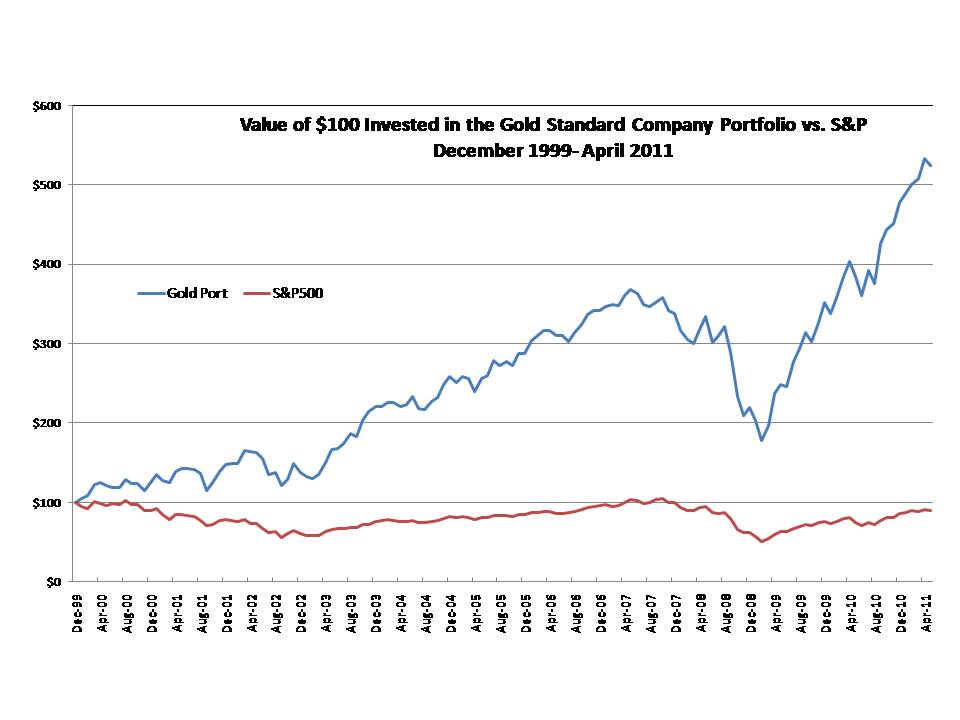
Trust Across America’s proprietary research confirms that the most trustworthy companies provide long-term benefits to all stakeholders, including shareholders. In November, 2010, our data identified 59 companies that met our benchmark standard for trustworthy business behavior.  The chart below is a graphic representation of the performance of the “Gold 59” from 1999- April 2011 vs. the S&P 500.


This group contains many “household” names like Aflac, Fed Ex, Lexmark and Cigna. Others are not as well known- Albemarle, Praxair, Ecolab and Lubrizol, which was acquired by Berkshire Hathaway earlier this year. But whether well known or unknown, they all share a common characteristic. They have integrated a culture of trustworthy business that benefits all stakeholders, including shareholders- representing the “best in breed” of sustainable business.

Charles Green, the Founder of Trusted Advisor Associates, sums up the case for building trust in business as follows.  “Reliance solely on economic and market-based tools works for mono-focus and short-terms; by contrast, trust scales as a management tool.  More deeply, trust itself is also built on extensive relationships over time. It is a natural way of doing business for those who believe in sustainability.”

Do you want to help us build the case for building trust?

Contact  Barbara Kimmel at barbara@trustacrossamerica.com or Jason Tapp at jason@trueaimconsulting.com


Aug
09

A colleague likes to remind me that all politics are local. But the sad fact is that so little, if any, are based on accountability or trust.  

This past year I have witnessed local “bad” politics set against the backdrop of national “worse” politics, and while the local players may not have nationally recognized names, their tactics are no different than what is playing out in Washington today. While some will say “who can blame them, just look at their role models,” this is no longer a satisfactory answer, at least not to me.

Two of our regional school board members are the subject of recall petitions filed by separate groups in different towns. The targeted officials are claiming that the recalls are about intimidation. I’m reminded that often when people accuse others of a specific character flaw or personality defect, they may be pointing to their own shortcomings. What further strikes me as odd is that these are the same individuals who I have personally seen intimidate their own members and the public, while disparaging and excluding those who don’t agree with them. 

The politicians are piling in to the local battle in the hopes of gaining “control”-  citizen activists, board members, town councils and mayors are all trying to grab their share of some elusive power pie, while balancing themselves on both sides of an imaginary political fence. Sound familiar? Lines are being drawn faster than summertime lightening strikes and alliances are made (and broken) with a mere phone call or wink of the eye. Meanwhile, the individual political motives and alliances remain nontransparent, finger pointing is rampant and the issues are spiraling out of control. If it sounds to you like a scene from the TV show Big Brother, it could be.

But what is the “real” issue at the local level? What makes it different than what’s going on in Washington? For me… well nothing.  We, as a nation, have tossed ethics and morality to the wind. Those in power, at whatever political level, have forgotten what it means to be “servant leaders” and to do so with humility, dignity and grace. Elected officials are no longer accountable to their constituents, nor do they perform their duties with integrity or trust. In this particular case, a regional school district full of kids is suffering. At the national level, the whole country feels the same pain. What a shame. We have nobody to blame but ourselves.

I live in small town America. I speak to those in neighboring towns and I hear that the issues are the same. Only the names and faces are different. Imagine this.  What if a copy of this blog was sent to every local school board, every town council and every mayor with a note that said “Say what you mean and do what you say. We, your citizens, are watching and we want you to help restore trust to this nation.”  Imagine if these elected officials began setting the examples, at the local level, that our country so desperately needs right now. What is the downside? Where is the risk?

Readers of this blog have the power to start a movement. Forward this short blog to your School Board, your Town Council and your Mayor. Ask them whether they want to continue to be part of the problem or part of the solution.  Remind them that collectively, they have the power to change the course of this nation.

Barbara Kimmel is the Executive Director of Trust Across America. Please feel free to send any questions or comments to barbara@trustacrossamerica.com

Jul
24

It seems like it is happening more frequently… those “accidental” billing errors imposed by companies… and I’m not referring to the pizza joint on the corner, but rather large and well known businesses that seem to think nothing of tacking on bogus charges, perhaps with the hope that only a small percentage of customers will notice, and the rest will  mistakenly pay these fees, much to the delight of the corporate coffer watchers and quarterly earnings manipulators.

In the past two weeks I have been on the receiving end of three corporate “scams.” Scam is an ugly and slanderous word, and I wouldn’t use it if I didn’t think it was accurate.

The first involved an estimated bill by a utility company (the actual bill was half, resulting in bill reduction of almost $300). The second offender was a “rent-a-car” company that imposed “phantom” gas charges, but could not produce any evidence of the actual gas used. The third was a large hotel chain that thought nothing of tacking on $32.00 in “honor bar” fees (you know- the jar of peanuts or package of M&M’s in the hotel room refrigerator), when, in reality, the honor bar was never accessed.

In the first and third instance, the extra fees were cancelled without a single question… almost too easily.  In the second case, two minutes of online research turned up an undercover investigation of this company’s deceptive and bogus gas charge practices. (I’m still working on resolving this one, as it is a bit more complicated. I did not rent the car directly. It was a service loaner from a “high end” auto manufacturer who was fixing my SUV. The interesting twist on this story is that the auto company released my personal credit card info to the rental company…but that’s a story for another discussion.)

And this brings me to Trust Across America’s metrics. As a followup to an article I wrote on the Role of Trust in Sustainabile Business, www.triplepundit.com/2011/07/role-trust-sustainable-business/, I decided to do a tiny study (of these 3 public companies) to see if there is a correlation between “good trust and good business” and what I found should not be surprising. Two of the three companies have below average aggregated trust scores. The third is slightly above average, but has a very low score in corporate integrity.  All three have at least one link that breaks the chain. The weak links are concentrated in corporate integrity and transparency- two of our five FACTS trust drivers- and certainly no surprise.

In conclusion, these are not companies that understand the benefits of trustworthy business behavior, nor have they adopted a culture of trust. In fact, they may believe that trust is not relevant to conducting good business. Unfortunately for them, as our world becomes more transparent, it will be more and more difficult for companies like these to sustain their business model. Oh well. I certainly won’t be sorry to see them go.

Trust Across America’s mission is to highlight companies that do the right thing.  This blog post is as close as we will come to reporting a scam. But let us know about your own corporate interactions, be they good or bad. Feel free to use actual names. We will be happy to provide some personal insight back to you regarding the company’s trust metrics. They must be public companies, and in our database.

www.trustacrossamerica.com/documents/offerings-reports/facts-audit.pdf

Jun
26

Trust Across America (TAA)  has set a standard for measuring trustworthy business behavior through our FACTS analysis, combining financial and non-financial metrics. TAA has been tracking the performance of the top companies based on our five FACTS drivers- Financial stability, Accounting conservativeness, Corporate integrity,Transparency and Sustainability.

Our proprietary research and external back-test of our universe of almost 3000 public companies confirm that the most trustworthy companies provide long-term benefits to all stakeholders, including shareholders. In November, 2010, our data selected 59 companies that met our “Gold Standard” of trustworthy business behavior.  The chart (link) below is a graphic representation of the performance of this group of companies since 1999 vs. the S&P 500.

Gold Company Performance

These Gold Standard companies are outperforming the S&P 500 by over 500% since 1999, and by approximately 35% since we began tracking them in November 2010.

This group contains many “household” names like Aflac, Fed Ex, Lexmark and Cigna. Others are not so well known- Albemarle, Praxair, Teco Energy and Lubrizol, which was recently acquired by Berkshire Hathaway.

But whether well known or unknown, they all share a common characteristic. They have adopted a culture of trustworthy business that benefits all stakeholders, including shareholders.

So while the news continues to be filled with stories about the lack of trust in business, companies actually can do good and be profitable at the same time.

Feb
14

Who Are the Tri –State’s Most Trustworthy Public Companies?

Even though trust in corporations is dropping nationwide,  many companies in the Tri-State area exhibit high levels of trustworthy behavior and many are surging ahead of the S&P as America recovers from its most recent recession. According to Trust Across America (TAA), the Tri-State area’s most trustworthy companies are:

New York:       

Gold- Hess Corporation                    

Silver- Transatlantic Holdings Inc.  

Bronze- Avon Products, Inc.            

For more details: tinyurl.com/4bn6zn3

New Jersey:          

Gold- Prudential Financial, Inc.

Silver- Cytec Industries Inc.

Bronze- Sealed Air Corporation

For more details: tinyurl.com/5t5cxlw

Connecticut:        

Gold- Praxair

Silver- Rockville Financial

Bronze- United Technologies

For more details: tinyurl.com/65ekk43

Trust Across America shines the spotlight on world-class companies exhibiting high levels of trustworthy business behavior, while providing a roadmap for other organizations to follow. Although trust was difficult to accurately measure in the past, TAA has compiled a composite set of trust metrics and worked closely with organizations that measure them.  The result is a new model called FACTS™, an acronym that stands for Financial stability and strength, Accounting conservativeness, Corporate integrity, Transparency, and Sustainability, with each factor evenly weighted. The power of this model is that it is objective, quantitative, and rich in independent metrics. 

Barbara Kimmel, Executive Director of Trust Across America states: “There are no perfect companies.  However, many companies have touted themselves as trustworthy and have been given a free ride because corporate America has lacked a definition of trust and tools to measure it. Our data can see through the smoke and mirrors.”

So while the news continues to be filled with surveys showing that consumer and investor mistrust of business is rising, we can now focus on the companies that are working hard to earn the public’s trust. As a result, consumers can now choose to do business with these trustworthy companies, while investors have an added level of protection from the next corporate scandal. 

 Trust Across America is a program of Next Decade, Inc., an award-winning firm that has been unraveling and simplifying complex business subjects for over 20 years. TAA provides a framework for public companies to improve trustworthy business practices, as well as showcasing role models that are exhibiting high levels of trust and integrity.