Jan
03

News Release

For Immediate Release

For Additional Information contact:

Barbara Kimmel

Executive Director

Trust Across America

908-879-6625


Trust in Business Essential for 2013:

Global Experts Join Forces to Combat Trust Crisis


Chester, N.J.  January 3, 2013—After a well-documented 10+ years of declining trust in government, business and the media, Trust Across America (TAA) (www.trustacrossamerica.com) and its ambassadors are launching the Campaign for Trust™, a two-year initiative to reverse this cycle.  “As the leaders in information, standards, data and the Who’s Who of trustworthy business, this is the next step in our initiative that began in 2009,” said Barbara Brooks Kimmel, a Co-founder and the Executive Director.

In the fourth quarter of 2012 TAA created The Alliance of Trustworthy Business Experts (ATBE) to collaborate in advancing the cause of trustworthy business through the creation of trust tools and communications outreach. Over 100 global thought leaders from Fortune 500 companies; leading academic institutions; global media and consulting have joined since the mid-October launch.

Much of the work of the alliance will be via strategic partnerships with our Founding Members listed alphabetically: Patricia Aburdene (Co-author of Megatrends 2000); William Benner (WW Consulting); Randy Conley (The Ken Blanchard Companies); Stephen M.R. Covey (Franklin Covey-Speed of Trust); Linda Fisher Thornton (Leading in Context); Bahar Gidwani (CSRHub); Charles Green (Trusted Advisor Associates); Nadine Hack (beCause Global Consulting); Michael Hopkins (MHC International); Gary Judd (Franklin Covey-Speed of Trust); Barbara Kimmel (Trust Across America); Jim Kouzes (The Leadership Challenge); Deb Krizmanich (Powernoodle); Mike Krzus (Co-author of One Report); Greg Link (Franklin Covey-Speed of Trust); Linda Locke (Reputare Consulting); Edward Marshall (Author Building Trust at the Speed of Change); Jon Mertz (Thin Difference); Deb Mills-Scofield (Innovanomics™); Robert Vanourek (Triple Crown Leadership); and Bob Whipple (Leadergrow Inc.).

According to Kimmel, “We will be assembling a Trust Toolbox™ in 2013 to assist businesses in building trust with their stakeholders. Collaborative projects in development include the publication of a book- Trust Inc.: Strategies for Building Your Company’s Most Valuable Asset, a collection of short essays from our global thought leaders; the Trust Directory™ designed for companies who seek advice and counsel; the creation of trust assessments; the development of a Trust Index™; educational Trust Talks™; a monthly publication called the Trust Sheet ™, announcing trust alliance member news from around the world; and the opening of our online Trust Store™, a virtual one-stop shop for trust products.”

Kicking off the campaign will be the January 14 announcement of Trust Across America’s 3rd annual Top Thought Leaders in Trustworthy Business. Our 2013 recognition list will honor the late Dr. Stephen R. Covey, whose professional accomplishments in the field of trust were instrumental to the founding of the Trust Across America initiative four years ago.

According to Amy Lyman co-founder of Great Place to Work Institute and author of The Trustworthy Leader, “The evidence is irrefutable. Cultures of trust, created by leaders who are credible, respectful and fair bring with them significant economic, social, community and environmental benefits. It is what every employee wants and what every business leader should strive for.” Trust Across America, through its new trust alliance, hopes to develop the requisite tools to enhance cultures of trust, and encourages those interested in furthering the cause of trustworthy business to join the alliance. trustacrossamerica.com/cgi-bin/alliance.cgi

-30-
 

Dec
14

Basic human decency- has it disappeared? It certainly seems that way- and perhaps this is why trustworthy business behavior has too.

My holiday wish for all of you is to consider the following professional business practices and share them with your team, every month beginning in January.  Together we can begin to rebuild human decency in 2013 and collectively elevate the level of trust in business. Naïve? – Maybe, but certainly worth a try.

January–  Promises: If you make a promise, keep it.

FebruaryBehavior: Practice what you preach.

MarchAccountability: If you say you are going to do something, follow through.

AprilObligations: If you owe someone money, pay them. Don’t hide behind your legal department.

MayIntegrity: If you are told something in confidence, don’t betray it.

JuneTeamwork: Have your colleague’s back.

JulyRespect:  Be on time for the meeting or the phone call.

AugustHonor: Your handshake should be worth as much as a written contract.

SeptemberHumility:  Be humble. Don’t brag about how much money you make and all the toys you bought with it.

OctoberSocial Responsibility: Practice good corporate social responsibility regardless of whether a “program” is in place to do it.

NovemberSelflessness: Think of others before yourself.

DecemberTrust:  Don’t forget that trustworthy business is not about quarterly earnings and international expansion, but rather about “doing the right thing.”

Barbara Kimmel, Executive Director

Trust Across America


You may direct questions or comments to Barbara@trustacrossamerica.com

Dec
08

It seems like business leaders may finally be waking up to the importance of trust as as a brand/company asset.

This week we heard from Sheryl Connolly Ford’s Futurist, about the increasing value of trust as the “new black” www.businessinsider.com/fords-biggest-trends-for-2013-2012-12, and from Cheryl Guerin Senior Vice President at Mastercard, positing that trust is an advantage for established companies. www.businessinsider.com/trust-could-be-the-achilles-heel-of-new-payment-companies-2012-12

Amen ladies! Perhaps it’s the Sheryls/Cheryls of the world, or female business leaders for that matter, who are about to turn the “trust” switch to the “on” position as a management tool that should not be ignored.  Trust is measurable and companies that embrace it as a business tool reap the rewards. Trust Across America has been preaching this, to a growing audience, for quite some time. www.trustacrossamerica.com/blog/?p=573

Let’s just hope that companies are genuinely waking up to the importance of stakeholder trust, rather than using trust as the latest “in” buzzword.


What do you think?


Barbara Kimmel, Executive Director

Trust Across America

Barbara@trustacrossamerica.com

The Steward of Trust for 2013

Nov
30

As the leading source of information, standards and data on trustworthy business, in mid- October, Trust Across America formed the Alliance of Trustworthy Business Experts. Its mission is to spearhead a global movement of recognized thought leaders who can advance the cause of trustworthy business behavior through collaborative, high impact programs and initiatives.

trustacrossamerica.com/cgi-bin/alliance.cgi

In less than six weeks, Alliance membership has grown to almost fifty international professionals hailing from corporations, nonprofits, academia, consulting and the media. Members run the professional gamut from Chief Ethics Officers of Fortune 200 companies to million+ bestselling book authors and well-known leadership experts.

We are thrilled to see institutions like the University of Virginia, Great Places to Work Institute, Federal Express and Triple Pundit, to name just a few, lending their collaborative support.

The Alliance offers both free and premium membership. All are welcome to join in furthering the cause of trustworthy business. Funds raised from premium members will be used to support the creation of collaborative tools to advance organizational trust.

We have begun work on a book project scheduled for publication in late 2013, and drawing on the expertise of many members who will be contributing solution-based essays on advancing trust in business.

Our first press release will be issued in early January 2013 when we will officially announce our founding members and further plans for the Alliance.

For more information, please contact Barbara Kimmel, Executive Director at the following email address: Barbara@trustacrossamerica.com


Oct
17

Regardless of the size of the organization, it’s no secret that every “buck” stops on the CEO’s desk and trust is no exception. A CEO who fails to “model” trust cannot build or maintain a sustainable business. So while the following “10 T’s of Trustworthy Leadership” may seem somewhat obvious to you, they may not be to your CEO. Share them the next time your team meets and deliver a copy of this blog to the CEO’s office. If he or she doesn’t thank you for it, you’re probably working for the wrong leader.

#1 Trustworthy- Very simply, a culture of trust cannot exist with an untrustworthy leader. Trustworthy behavior must start at the top and flow down through every manager within the organization. Trust building tools should be incorporated into meetings. Management should reward those who model trust and CEO’s should regularly address all stakeholders about the steps being taken to build trustworthy behavior within the organization.

#2 Tools- and speaking of tools, there are many trust tools that CEO’s can utilize to build trust amongst their internal and external stakeholders. They run the gamut from metrics to assessments and online surveys. The results may be surprisingly good, or just the opposite. And if they are the latter, it’s time to get busy.  Either way, maybe it’s time to add a Chief Trust Officer to the staff. And remember, what can be measured can be managed.

#3 Treatment- The Golden Rule says to “treat others the way you want to be treated” and certainly holds true with trust. The CEO that extends trust to his/her stakeholders is more likely to have it returned.

#4 Teamwork- As we all know, teamwork leads to better decisions and better outcomes. Breaking down the silos to make trustworthy behavior the #1 priority in the C-Suite, should be on every CEO’s “to do” list. Trust should not be confused with compliance. Being “legal” is not the same as being trustworthy.

#5 Talk- Your stakeholders need to know what steps you are taking to build a trustworthy organization. Let’s face facts, quarterly numbers are no longer the “be all and end all,” and the evidence is building that one need not sacrifice “good numbers” for a trustworthy culture. Companies can simultaneously “do good and do well. “ www.trustacrossamerica.com/blog/?p=573

#6 Truth- for goodness sake, any CEO who wants to build a trustworthy organization, must always tell the truth. No company is perfect. It’s not necessary to air all the dirty laundry, just don’t lie about it.

#7 Time- Building a culture of trustworthy business does not happen overnight. It takes time, maybe even years. The CEO who invests the time to educate himself or herself about how to build trust among teams and with stakeholders, develops a plan, communicates and implements it, will be rewarded with greater stakeholder trust. And when the slip up occurs, those who “banked” trust will recover faster.

#8 Transparency- Merriam Webster defines “transparent” as characterized by visibility or accessibility of information especially concerning business practices. Any CEO who thinks he/or she can still hide behind a veil of secrecy need only spend a few minutes on the social networks reading what stakeholders are saying about his/her company. Why not be proactive? It’s time to stop viewing transparency as a risk.

#9 Thoughtful- that’s not to say that stakeholders must know the company’s trade secrets or what the CEO had for dinner. But the CEO who thinks about building a trustworthy organization, might consider making “trust” more prominent through a well-developed communications strategy. It’s still the rare company that makes trust a priority, so if yours is one of the few that do, why not brag about it? Your stakeholders will thank you for it.

#10 Tweet- If Bill George sees a reason to do it, it’s probably time you did too!

online.wsj.com/article/SB10000872396390444083304578018423363962886.html?mod=rss_Technology


Barbara Kimmel is the Executive Director of Trust Across America, the leading source of information, standards and data on trustworthy business.

She is also the self-designated Tribal Chief of The Alliance of Trustworthy Business Experts (#trusttribe)

trustacrossamerica.com/cgi-bin/alliance.cgi

Barbara was recently named one of 25 Women Changing the World 2012

You can follow her on Twitter @BarbaraKimmel and direct comments to

Barbara@trustacrossamerica.com


Sep
27


Good Business New York Leading Women for 2012 has named Trust Across America’s Founder, Barbara Kimmel, among its honorees.

The accomplished women listed below inspire us, surprise us, and give us hope that the world can be a better place. Each of these determined women honored this year is working diligently to solve critical social and economic problems.

These courageous women tackle our most challenging modern issues including environmental sustainability, human rights, business trust, equitable capital allocation, social enterprise, women’s economic empowerment, and ethical leadership with indefatigable energy and dedication.

The “Good Business New York™ Leading Women of 2012” includes economists, lawyers, thought leaders, journalists, policy makers, activists, investors, corporate executives, entrepreneurs, philanthropists, scientists, quants, and academics. Some are known to us personally at Good-b; others are not. All of these women have been selected for their impact and effectiveness in the world of business and finance.

We live in times of crises. Critical social and economic challenges are more important than ever to address, and even more importantly to resolve. These women are among the champions and change makers who are creating real and positive change. Most of these women are well known in their circles, but none are household names. Some operate behind-the-scenes; others take center stage. Our goal atGood Business New York™ is to celebrate the important work that each of these remarkable women do everyday with committment, personal sacrifice,  passion, purpose, and sheer determination – work that might sometimes go unnoticed by the general population, but is never-the-less shaping the positive changes taking place in business and society.  At Good Business New York™, we honor the triumphs and accomplishments of these 25 Leading Women in the face of real challenges.

After eight months of deliberation and research at Good Business New York™, we have selected 25 amazing women to represent the power that one person has to make a big difference. We believe they deserve even greater recognition for the socially, environmentally, and economically sustainable work they do every day. They serve as role models for women and girls everywhere.

We celebrate these 25 dynamic women who inspire and empower us to create a better world for all. The“Good Business New York™ Leading Women for 2012” offer us hope that a more equitable and sustainable economy is possible, one that serves all levels of society fairly and responsibly and doesn’t leave millions of the world’s inhabitants out. We congratulate and applaud all of them for what they do every day for our communities and our world.

To review the complete list, please click on the link below.

good-b.com/?p=10329

“I am honored to be included among this list of outstanding women,” said Barbara Kimmel. “This recognition reconfirms that the work I am doing at Trust Across America is not only helping to restore trust in the business community, but is also being more widely acknowledged by prestigious organizations like Good Business New York”.


Aug
26

Will you join Trust Across America in a pledge to model trustworthy business behavior?

Curtis C. Verschoor, CMA, a member of the IMA Committee on Ethics and one of Trust Across America’s Top Thought Leaders in Trustworthy Business Behavior trustacrossamerica.com/offerings-thought-leaders.shtml recently wrote a blog post called A Disturbing Thirty Days www.accountingweb.com/article/disturbing-thirty-days/219658

Essentially, the post talks about the enormous worldwide corporate transgressions that occurred from mid-June to mid-July 2012 beginning with $4 billion in fraud and ethics fines levied against the pharmaceutical industry. The enormity of these global trust violations is staggering.

Life is a series of small interpersonal transactions that either build trust or lose trust. I believe that the economics of trust works as follows: every small positive deed, whether seen or unseen, adds to ones personal and professional value. In this environment, a single transgression can derail decades worth of “brand” building if trust has not been “banked”.

Lately I’ve thought quite a bit about trust violations and what’s behind them. In most cases, the root cause of the breakdown of trust is self-serving and self-interested behavior, often on the part of those in the most trusted positions in business. While all professionals, regardless of their field, can build and bank trust, sadly few choose to. Even those who work in the fields of trust and ethics don’t always take the high road. And so here we are today witnessing some of the worlds largest companies paying billions of dollars in fraud and ethics fines, with no apparent end in sight.

Most of us have fallen victim to trust violations, and while the “big” cases, like those referenced in the link above, make the news, the day-to-day transgressions may not. Regardless of their size, trust violations harm interpersonal, inter-organizational and international relations.

Franklin Delano Roosevelt’s second inaugural address in 1937 included the following passage. “We have always known that heedless self interest was bad morals, we now know that it is bad economics. Out of the collapse of a prosperity whose builders boasted their practicality has come the conviction that in the long run economic morality pays.” Roosevelt was correct. Economic morality does pay but it seems that the business world needs a reminder.

Will you join Trust Across America in a pledge to model trustworthy business behavior? Will you take that pledge today? Will you serve as a role model for your children, your friends and your co-workers? Will you remind them (as often as needed) that economic morality pays? Will you share this short blog post with those who have banked trust and those who should start?

On Twitter: #pledgetobetrustworthy

Barbara Kimmel is the Executive Director of Trust Across America. Send your comments to barbara at trustacrossamerica.com


Aug
21

Trust Across America (TAA) receives frequent inquiries from the financial media. Here’s how the conversation usually goes.

TAA: Hello TAA. How can I help you?

Media: Hi! This is Debbie Downer from major financial news network. We understand that TAA ranks public companies according to their trustworthiness. Is that correct?

TAA: Yes we maintain a database of approximately 2500 public companies and our FACTS® Algorithm can measure the major drivers of trustworthy business behavior. We can even show you how each company ranks according to its market cap, industry and sector peers.

Media: Great. Can we get a list of the lowest ranked companies?

TAA: Just to clarify. You want a list of the least trustworthy companies?

Media: Yes

TAA: Sorry but TAA’s mission is to highlight the good guys. How about if we give you some examples of companies doing good and doing well at the same time?

Media: Good guys? No thanks. The public is not interested. Only bad news sells.

Click.

Jonathan Low at www.lowdownblog.com recently wrote about the disappearance of the small investor, and with the help of Barry Ritholtz www.ritholtz.com/blog/ listed 10 reasons why. I propose #11.

#11 The financial media industry is obsessed with bad news and scandals of the day. How will confidence in the financial markets ever be restored if this cycle continues? Jonathan and Barry, it’s really not a matter of poor returns. There are great companies who are meeting the needs of all their stakeholders including their shareholders.

It’s the responsibility of the financial news networks to refocus. Report to the public about companies that are behaving in a trustworthy manner. A few names that come to mind are Accenture (Symbol: ACN) and United Natural Foods (Symbol: UNFI). We are not suggesting that these companies are perfect. They may trip along the way.  But our research shows that they will also recover much faster. They have “banked” trust.

So to all the Debbie Downers of the financial news networks. Here’s my suggestion. Try highlighting a few of the good guys. Treat the public with more respect. Use this as an opportunity to be a positive role model for the rest of your industry. Don’t be part of the race to the bottom. Don’t be that guy (or gal)!

What do you think? Should the financial news networks report more good news? Send your comments to barbara at trustacrossamerica.com

Aug
21

Anyone still hesitating to embrace the business notion that trust is an asset – an asset that can leverage real business gains – should look at the ongoing data from Trust Across America (TAA) comparing companies with strong trust profiles to all other companies.   TAA is a US-based think tank exploring the issues of corporate trust and the relationship between trustworthy business and company performance in America – this, at a time when we feel corporate trust is not only rare, but also misunderstood and unappreciated as a business-building tool.

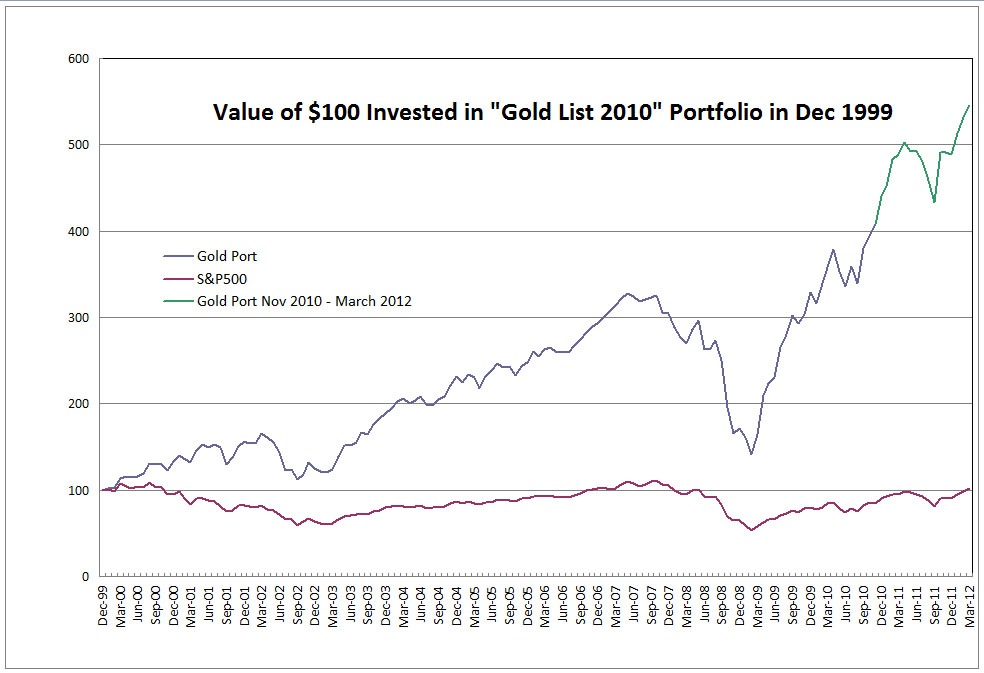
Among the empirical data we have collected over three years studying 3,000 US public companies, is the vivid performance of our “Gold 59” – including US brands such as Mattel, United Natural Foods and Accenture.   The Gold 59 comprises the US-based public companies that met our minimum benchmarks of trustworthy business behavior – which essentially means an above-average score in each of our five drivers of trust including Financial stability, Accounting Conservativeness, Corporate Integrity, Transparency and Sustainability (FACTS®). While many companies may be strong in multiple drivers, our research shows that a “weak link breaks the chain” and this is why only 59 companies qualified.

Compared to the S&P Index, an accepted standard for stock performance among some of the largest 500 companies in America, the Gold 59 is presently 500 basis points (or 5%) ahead since November 2010 when TAA began to formally share its data. Certainly the 10-year trend is even more enlightening, compared to a very stagnant S&P.


Source: Trust Across America May 2012

  We can point to five critical areas that show why the Gold 59 is so much further ahead of the S&P:

  • Governance: Companies that made it into our Gold 59 put transparency and governance high on their priorities lists to ensure they have operations that meet and exceed the minimum standards expected. They are not “just compliant.”
  • Stakeholder Engagement: Trust is a tango of at least two, and companies that engaged key stakeholders in meaningful, two-way communication received unbiased high trust marks.
  • Consistency: There is nothing like being reliably consistent in delivering on product and service excellence and business performance to solidify trust with the audiences that make a business succeed.
  • Authenticity: “Keeping it real” is a motto that rises to the highest levels in business performance, which means being honest about successes, failures, goofs and unexpected triumphs.
  • Relevance: Companies that reflect real needs and real opportunities are the companies that attract the highest level of interest and potential for trust dividends by delivering on those high expectations. Sales increase because customers like doing business with trustworthy companies. We see this in other highly ranked FACTS companies like Nike and Starbucks.

“When we deliberately and consistently behave in ways that inspire trust, we will experience high-trust ‘dividends’,” says Stephen M.R. Covey, author of the bestseller The Speed of Trust. “There are actual economics to high trust – the dividends of greater speed and lower cost – just like there are economics to low trust – the “taxes” of lower speed and higher cost.  These economics of trust are experienced in relationships, on teams and in organizations, and ultimately these economics translate and extend into the financial marketplace.”

Perhaps the most exciting aspect of trusted companies “beating the street’ is the evidence of the upward virtuous cycle that is created because of the reciprocal nature of trust. When we trust people, they tend to trust us back. When we reward trusting behavior in organizations, it begets more trust-building behavior — which is the essence of a free and civil society.   The Gold 59 proves that the market values trustworthy behavior.   So why does the crisis of distrust continue and why are companies not running to prove their trustworthiness?   This is the inspiration for many more columns on the asset of corporate trust, but it boils down to a system that makes other assets priorities over trust – specifically, antiquated notions of shareholder value and settling for regulatory compliance as the marker of ethical behavior, among other distractions. The value of a company is derived from the relationships it maintains will all its stakeholders, not just shareholders. When we look at corporate performance we can no longer look at the short-term and we cannot merely look at investors.

If we study the other 2,941 pubic companies that don’t meet TAA’s minimum threshold for trustworthy business behavior, we see how rare trust is and how easily poor performance is justified by the apparent fact that “everyone else is doing it.” Trust leadership requires a more progressive stance on building authentic relationships with stakeholders – a relationship that pays trust dividends.  It also requires a long-term focus. And for those pioneers in valuing trust and investing in trust, the upside is clear –and the short-term takes care of it self.

Barbara Kimmel, Executive Director of Trust Across America (TAA), a US based think tank and communications program (www.trustacrossamerica.com) whose mission is to restore corporate trust. Email your thoughts and ideas to barbara at trustacrossamerica.com

Apr
17


Trust Across America™, a think tank and communications program dedicated to unraveling the complexities of trustworthy business behavior, today announced its participation as a founding member of BEST! Business Excellence through Sustainable Trust. Barbara Kimmel, Executive Director states:

“We are living through a crisis of trust in organizations and many of today’s news channels are stuck on one channel . . . what is wrong in corporate America. BEST! – a collaborative media-based program showcasing best practices in building and maintaining trust ‑ will draw public attention to what is right –– with the goal of restoring trust in business, and combating the often misplaced perception of systemic corporate greed.”


BEST! is a “by invitation” program that leverages a voluntary fraternity of well-respected media organizations to collaboratively disseminate articles about corporate leadership, innovation and success ‑ to a guaranteed audience. We want to showcase role models for other companies to emulate.


The founding members of BEST! reach an audience of millions through their websites, media outreach and social networking. Companies selected to participate as BEST! members will be guaranteed coverage to this wide audience. Additional media are expected to join as the program expands in scope and awareness.


Accountability-Central

CSRWire

Ethical Markets Media

Forbes.com

Good-B

Marketwire

Trust Across America

Trusted Advsior Associates

Triple Pundit

Voice America Radio


Trust Across America (TAA) is a program of Next Decade, Inc., an award-winning firm that has been unraveling and simplifying complex subjects for over 20 years. TAA provides a framework for public companies to improve trustworthy business practices through detailed individual company reports, industry and sector analyses, and an index of its data. TAA also provides a variety of media opportunities to highlight companies and leaders exhibiting high levels of trust and integrity.

###

For more information on this topic please visit trustacrossamerica.com/best.shtml

To schedule an interview with Barbara Kimmel, please call (908) 879-6625 or email barbara@trustacrossamerica.com