Apr
15


TAA_R2_EDIT-CS3


Last week we announced the results of our 4th annual “Most Trustworthy Companies,” ranking almost 2500 US based, publicly traded companies on 5 indicators of trustworthy business behavior. Utilizing our proprietary FACTS Framework, Trust Across America picks up where other lists leave off, analyzing Financial stability, Accounting conservativeness, Corporate governance, Transparency and Sustainability from several independent data sources.


The “Top Ten” companies are shown below.

#1 Manpower Group (MAN), human resource consulting firm

#2 Hormel Foods (HRL), food producer

#3 Jones Lang Lasalle (JLL), commercial real estate

#4 CA Technologies, Inc. (CA), computer software

#5 The Boeing Company (BA), aerospace

#6 CBRE Group (CBG), commercial real estate

#7 Capital One Financial Corporation (COF), bank holding company

#8 The Sherwin Williams Company (SHW), general building materials

#9 Lexmark International, Inc. (LXK), office equipment

#10 Delta Airlines (DAL), transportation


The full press release is reproduced here.


This week we compare the performance of this group to the S&P 500.


Are you surprised about the recent past performance of these companies against the S&P 500? We aren’t. The business case for trust has been proven once again.


One-year return for “Top 10” vs. S&P 500:  38.8% vs. 17.59%, or 120% higher.

Two-year return for “Top 10” vs. S&P 500:  65.74% vs. 33.29%, or 97% higher.

Five-year return for “Top 10” vs. S&P 500: 240% vs. 114.81%, or 109% higher.

*Returns do not include dividends but the yield is similar to the S&P 500.

*While the returns show past performance of the ten companies, a live portfolio being rebalanced monthly has a similar profile.


Investors can choose to support trustworthy companies who are doing business “well” and are also highly profitable. This creates a virtuous cycle whereby less trustworthy companies may be inclined to focus more on corporate culture and  less on quarterly returns.

For more information, tools and programs on building trust in your organization, please visit us at Trust Across America.
Apr
09

Who are America’s Most Trustworthy Public Companies for 2013?


Trust Across America picks up where the “other” list leaves off, looking at 5 indicator of trustworthy business from three independent data sources.


Here’s our latest press release.

Mar
16

TAA_R2_EDIT-CS3


What stops companies from building a culture of authentic long-term trust? As transparency increases, so does the ability of every citizen to look behind the curtain, with the click of a Google search.


I’m not trying to win a popularity contest with this blog post, at least not with corporate America. But hey, ask most C-Suite folks about trust issues in their organization and they won’t hesitate to emphatically tell you they have not a single one.

Last week I attended an event featuring two guest speakers (also sponsors) from large global companies in different industries. At the end of their respective speeches everyone in the audience applauded loudly except for me, and one other attendee. The other attendee “gets” trust like very few others. Based on their professional credentials, it’s understandable. Think nurse or military leader.

What made these speeches so excruciatingly painful?

First the canned, compliance-approved content, and second, the cult-like focus on the corporate responsibility programs of both organizations. While Trust Across America’s FACTS® Framework shows us that no company is perfect, both of the sponsor firms have recently paid massive fines for, let’s (politely) say, ethics violations. Not the first fine for either, and probably not the last, and just a mere “blip” on the quarterly earnings radar. So whom are they kidding? Judging from the applause, the vast majority of the audience.

As transparency increases, so does the ability of every citizen to look behind the curtain, with the click of a Google search.  All it takes is a few minutes and a curious mind. Corporate responsibility is an important component of a trustworthy organization but it’s only one component. I’m not suggesting that companies air their dirty laundry in public. What I am suggesting is that they stop using the corporate responsibility officer as a public relations pawn.  It may work now, but it is a short-term, unsustainable strategy.  When the next ethics “oops” occurs, it may be the one that brings down the house, and nobody is going to care about the organization’s philanthropic efforts.

What if the C-Suite were to lead with a culture of trust by creating a long-term trust-building strategy and sent their CR officer into the field to talk about that instead? What if they discussed the company’s values statement or corporate credo, and how it meets the needs of all their stakeholders?  What’s stopping companies from building their culture around authentic long-term trust? Is it the legal department?

And finally, the cherry on the weekly “trust cake” is contained in this article in which the author suggests that telling the truth undermines trust.

Next week is the start of spring. It’s also my birthday. Maybe the cake will be a bit less stale. Maybe the most popular flavor will change from artificial vanilla-coating to trust.

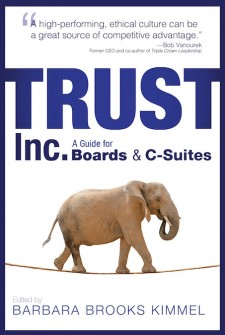
For more information on building trust in your organization you can read our new book, Trust Inc., Strategies for Building Your Company’s Most Valuable Asset.


Mar
10


TAA_R2_EDIT-CS3


Every year at this time I start feeling like a kid in a candy shop!

Why? Not only is Spring right around the corner, but so is the release of our annual Most Trustworthy Public Companies, a list we have been publishing for the past three years.

It’s time to starting poring over massive Excel spread sheets to identify those companies rising to the top of our FACTS Framework, or said another way, those companies that crush their competitors on all indicators of trustworthy business behavior. Who will these companies be for 2013? We’ll let you know on April 15th!

What if I told you that trustworthy companies “beat the Street” by over 100%? 

This picture tells its own story. FACTS is represented by the green line on top and the vertical axis is the percentage change in stock price. From August 2012 through February 2014, the S&P 500 is up 34.8% not including dividends, and our FACTS Model returns are 72.9% not including our dividends. That’s slightly more than 2X the market.

FACTS314

FACTS (an acronym) selects companies on the basis of their Financial stability, Accounting quality, Corporate integrity, Transparency, and Sustainability. See link

But why take our word for the Business Case for Trust? Here’s some additional expert input from Gallup, The Washington Post, Edelman, Harvard, The Economist, Fortune and Forbes.

And finally, for those of you who still aren’t convinced, you can read a heartwarming story about Warren Buffet, friendship and trust. This is a link to the book referenced in the article.

Please send me a note at barbara@trustacrossamerica.com if you have any questions or comments about this post.

If not, see you on April 15th when our 2013 Most Trustworthy Public Companies is released.

Mar
04

TAA_R2_EDIT-CS3


A  three minute video like nothing you have ever seen before!


Watch it Here 


Feb
21

TAA_R2_EDIT-CS3


Earlier this week I was given a gift, the opportunity to chat about trust with 150 very smart college kids, members of the millennial generation. 

A small group met for dinner before class, including two international students who shared their stories about trust and cultural differences. For example, in some countries it is impolite to make eye contact with someone who is older. This is viewed as disrespectful and untrustworthy. Imagine walking into a job interview in the US and being unwilling to make eye contact with the interviewer!

We began our class discussion by asking three questions but ran short on time before the third topic.

Question #1: Whom do you trust the most?

Answer #1: Family- Mother, father and siblings. We discussed the special bonds among family members that create trustworthy relationships and how these same characteristics translate into larger organizations.

  1. Familiarity
  2. Longevity
  3. Common values
  4. Having “your back”
  5. Culture

Question #2: What company do you trust the most?

Answer #2: Google and Apple- The water became a bit murky as the students  explored differences between “liking a product” and “trusting a company” and between consumer perceptions and organizational trustworthiness.

We discussed the lack of transparency at these particular companies and the chapter in our book Trust Inc., addressing Apple as a case study in trust. Several students shared their strong beliefs about corporate responsibility vs. corporate window dressing.

The discussion then turned to:

Target’s security breach: The majority concluded that the breach will not inhibit them from shopping at Target.

Trust in government:  The students felt strongly that our government does a good job to protect its citizens. They accept that lying is the “norm” in politics. Many said they would vote for Chris Christie even if a determination is made that he lied about the lane closures in Fort Lee.

Wrapping up, we reminded the kids that they live in an era of radical transparency. It’s becoming increasingly difficult to hide bad behavior.

We emphasized the importance of entering the work force with not only a clean slate, but also knowledge of the importance of leading with trust.

Bottom line, the students were very engaged in the “trust conversation.”  Perhaps it should be held on more college campuses. What do you think?

Share your comments with me. barbara@trustacrossamerica.com

Feb
15

Ten Trust Busters


TAA_R2_EDIT-CS3


Are your actions ethical? What impact are they having on others? Is unethical behavior just “business as usual?”


I recently followed a LinkedIn group thread containing the following discussion topic: In the personal life of an ethics professional, do the same standards apply as in their professional life? A debate ensued, with many taking the position that “it was just a job” no different than any other profession. In other words, “all bets were off” outside the office. As disappointing as this might seem, it was not particularly surprising.  I see similar attitudes and behavior among trust professionals. Maybe we all need an occasional reminder of what makes for ethical and trustworthy behavior, both in and outside the office. Here are a few thoughts taken from real-life examples:

  1. Lose your “me first” attitude.
  2. Stop belittling others.
  3. Don’t claim honors and awards that you did not earn.
  4. Don’t make “side deals.”
  5. Do your own “dirty work.” Don’t send a soldier to do it for you.
  6. Don’t help yourself to the copyrighted content of others without asking.
  7. Leave your ego at the door. You may not be the smartest person in the room.
  8. Tell the truth.
  9. Keep your word.
  10. If you are not sure your actions will be viewed as ethical or trustworthy, ask before proceeding.

I believe we all have a personal and professional obligation to hold ourselves to high standards, to be role models and to exhibit integrity and character. We have an obligation to walk our talk. We have an obligation to lead with trust. Stop and consider whether your actions are ethical and the impact they will have on others.  A lack of trust and ethics should not be viewed as “business as usual.” It’s just bad business.

For more information about organizational trust, please visit our website at www.trustacrossamerica.com You may also be interested in our new book, Trust Inc.: Strategies for Building Your Company’s Most Valuable Asset

Trust Inc.

Trust Inc.


What are some additional trust busters that you would like to see added to this list? Feel free to leave a comment!

Barbara Brooks Kimmel, Executive Director, Trust Across America-Trust Around the World

Feb
13

Trust and Approval

TAA_R2_EDIT-CS3


How often do you hear one of these statements?

“I need to get approval to do (or say) that.”

“I need to clear this through compliance.”

“You can’t quote me if I don’t get permission.”

“I can’t help you without approval.”

Have you ever considered the relationship, within an organization, between approval and trust?

I’m not referring to the first definition of “approval” from Merriam-Webster, but rather the second shown below.

1. The belief that something or someone is good or acceptable: a good opinion of someone or something

2. Permission to do something: acceptance of an idea, action, plan, etc.

Think about how many employees are constrained by an “approval process,” and how this impacts speed of innovation and decision-making as well as employee engagement. Think about how costly this is. Every time someone needs approval to say something or do something, the “approval” process impedes the outcome. In fact, the process may be so daunting, that employees choose to take the “easy” road, never creating anything new or suggesting a new idea. After all, it would require approval.

What if leaders chose to extend trust throughout the organization by never requiring approval for ANYTHING?

Instead CEOs and their Boards took the time to craft long-term credos, vision and values statements and/or Codes of Conduct; and they were more than just “slogans” etched into the wall at corporate headquarters. The entire staff, starting with the CEO, lived the values every day, and employees understood, at the time of hiring, that any “values violation” would result in immediate termination. Now imagine the innovation, speed of decision-making and empowerment that would come from this cultural transformation. Imagine the cost savings.

During the editing process of our new book Trust Inc. I spent time searching the websites of several large public companies. The goal was to include an Appendix of examples of well-crafted values statements. I was surprised at how difficult they were to find online, and when I did, most of them were “just talk” or empty words. The few I did locate could not be included as written without “approval” from the respective company’s legal department. This would have delayed the publication of the book by several months (not days.) I did a “work around” of the approval process, eliminating the company name.

If organizations spent more time building values instead of  layers of legal teams and compliance departments, the word “approval” would start to look more like Merriam-Webster’s first definition: The belief that something or someone is good or acceptable: a good opinion of someone or something. 

The word “approval” would start to look more like trust.

What do you think? Please feel free to leave a comment or send me a note at barbara@trustacrossamerica.com

Feb
03


TAA_R2_EDIT-CS3


Building organizational trust requires leadership “buy-in.” The payoff includes a happier and more stable work force; faster decision making and innovation; and long-term sustainability and profitability.

This list compiles some of the myths surrounding organizational trust and leadership.

  1. Trust is “soft” and does not increase profitability.
  2. If an organization complies with the law, it is trustworthy.
  3. Leaders need not have integrity in their personal life as long as they act the part at work.
  4. Writing a corporate values statement or having a credo is a waste of time and resources.
  5. Building trust into the corporate DNA will not result in faster crisis recovery.
  6. Short-term profitability trumps long-term trustworthiness.
  7. It’s not leader’s job to ensure that trust-building is an organizational priority.
  8. Shareholders are more important than other stakeholders.
  9. Corporate responsibility need not extend beyond philanthropy.
  10. It’s okay to tell an occasional lie.

What myths would you add to this list? Leave a comment.

These myths and other are discussed in our new book, Trust Inc. Strategies for Building Your Company’s Most Valuable Asset.

Trust Inc.

Trust Inc.

Jan
31

TAA_R2_EDIT-CS3


February is Leadership Transformation Month

according to Trust Across America’s


2014 Calendar


Productivity and execution begin when the leader creates a set of values and goals that are shared, accepted and adopted by all stakeholders.

Leaders must regularly communicate with stakeholders about the steps being taken to build trustworthy behavior within the organization.

Leaders must not confuse trust with compliance. The latter is situational. The former is not!

During the  52 weeks of 2014 you can build trust in your organization by thinking about, discussing and following the advice of the experts. Here are the suggestions for the 4 weeks in February 2014.

Week 1: A person “like yourself” is now trusted nearly two times as much as a CEO or government official. Ben Boyd, Edelman

Week 2: When deciding whom to trust remember this, people who will lie for you will lie to you. Lea Brovedani

Week 3: When I trust you, I empower you to influence me.  Elaine Cohen, Beyond Business Ltd.

Week 4: When achieved, organizational trust is validated externally in corporate reputation and performance. Mark Coleman, Convergence Mitigation Management


Please share your comments and suggestions! Email: barbara@trustacrossamerica.com

Barbara Brooks Kimmel, Executive Director, Trust Across America – Trust Around the World

Editor  Trust Inc. Strategies for Building Your Company’s Most Valuable Asset

Trust Inc.
Trust Inc.