Archive

Posts Tagged ‘trust’

May
04


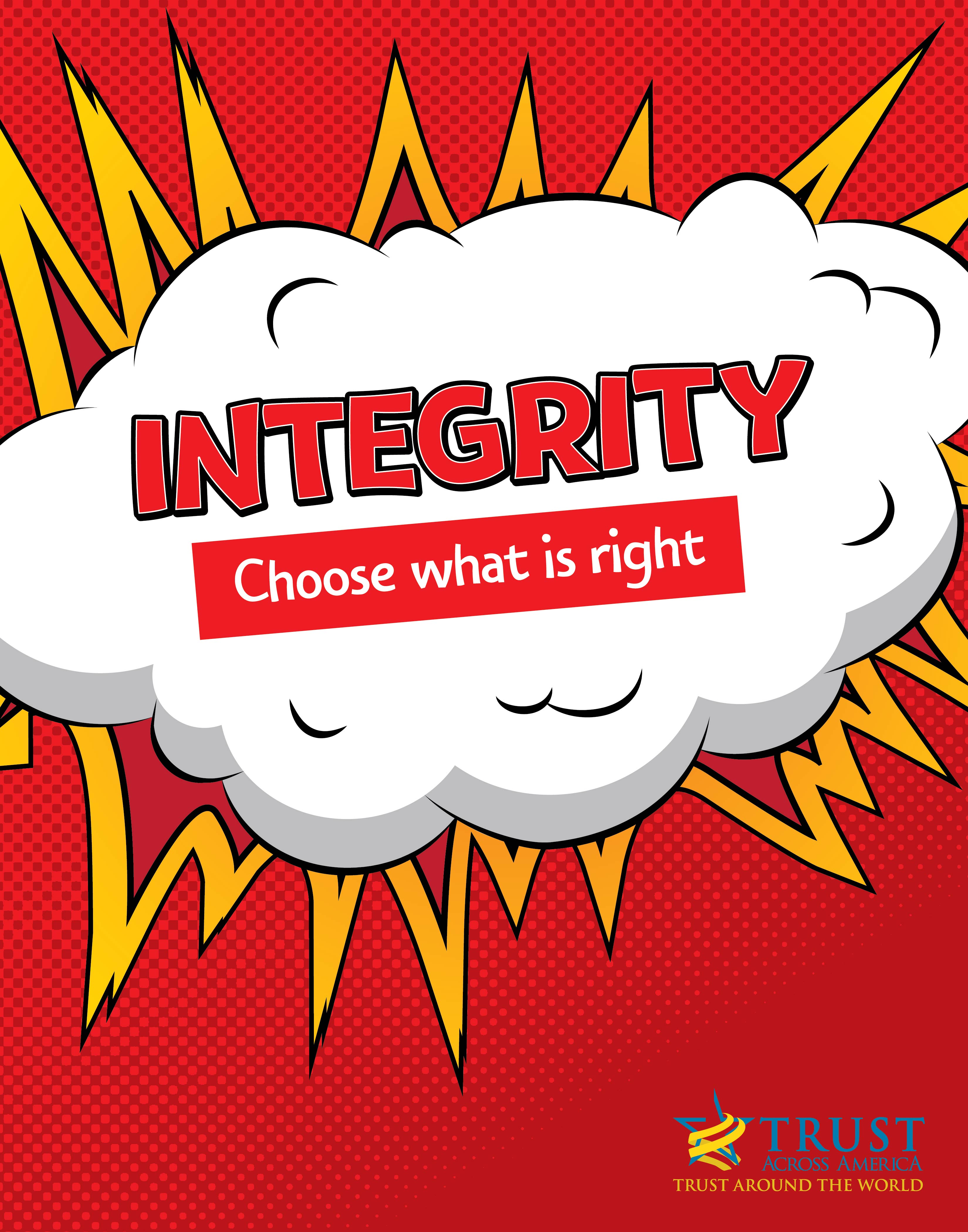
What is Integrity? 

It is choosing to do what is right not just what’s regulated or legal.

Integrity is the fourth of *12 behaviors in our Tap Into Trust (TAP) framework having now been accessed over 150,000 times in 16 languages. 

Trust Across America-Trust Around the World created The “Art” of Trust visual “cues” to start a discussion about workplace behaviors that build and weaken stakeholder trust. Together these cues form a “Wall” of Trust, telling a story to enhance learning and retention.


In the context of building team and stakeholder trust, we define “Integrity” as follows:

We do what we say – our everyday actions and talk are consistent.


To date, over 26% of our 600+ survey respondents identified “integrity” as lacking in their workplace.

Here are two discussion questions our Trust Alliance members suggest to elevate integrity and build workplace trust.

  1. Do we have and post our company’s values?  If so, do we have a system in place whereby employees are invited annually to evaluate leadership’s adherence to its posted company values? 
  2. What are some examples of our failure to act in the best interests of our customers, stakeholders and the public?


The “Art” of Trust  is one of many resources designed for our Trust Action Project to help leaders, teams and organizations move from trust talk to ACTION in 2021 and beyond.

Would you like to build a Wall of Trust for your team? Take the first step.


Join our global Trust Alliance and participate in our programs.

Learn more about the Trust Action Project 2021 at this link.

*TAP INTO TRUST is an acronym. The 12 behaviors are equally weighted. The weakest behaviors break the trust chain.

Copyright 2021, Next Decade, Inc.

, , , , , ,

Apr
20

What role does ACCOUNTABILITY play in building trust in your workplace?

A BIG one.


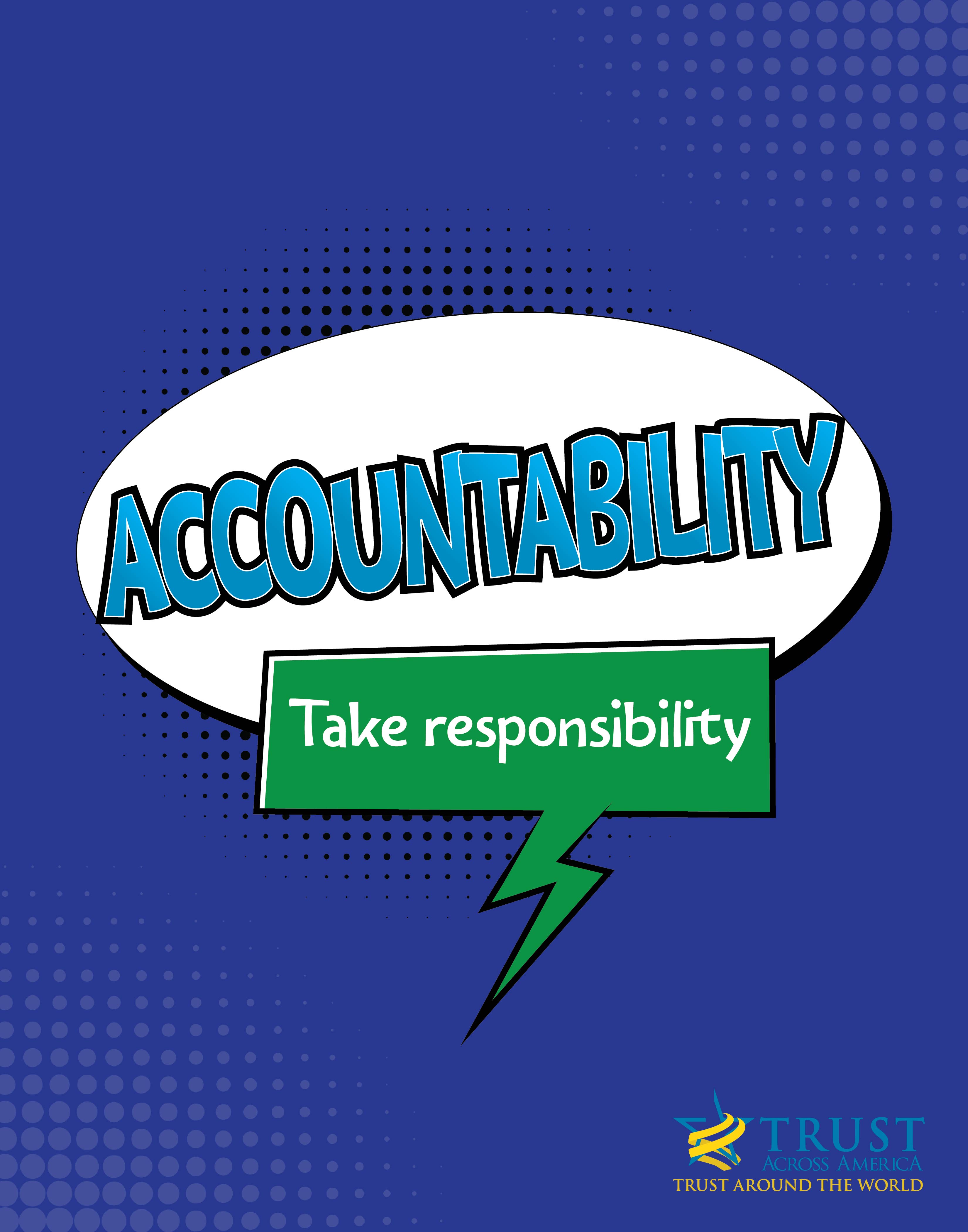
Accountability is the second of *12 behaviors in our Tap Into Trust (TAP) framework having now been accessed over 150,000 times in 16 languages. 

Trust Across America-Trust Around the World created The “Art” of Trust visual “cues” to start a discussion about behaviors in the workplace that build and weaken trust. Together these cues form a “Wall” of Trust, telling a story to enhance learning and retention.


In the context of a team, we define Accountability as follows:

We hold one another accountable –

we each take responsibility without regard to level or role.

Over 600 survey respondents identified accountability as the top behavior weakening trust in their workplace (over 43%). If accountability is lacking on your team how do you begin to address it? These are two discussion questions our Trust Alliance members suggest to improve trust.

  1. Do we hold people accountable in a principle-centered rather than punitive way?  If not, how do we change this?
  2. Do our accountability discussions demonstrate that we are on the same team?  If not, how can we help team members take collective responsibility?

The “Art” of Trust  is one of many resources designed for this year’s Trust Action Project to help leaders, teams and organizations move from trust talk to ACTION in 2021 and beyond.

Would you like to build a Wall of Trust for your team? Take the first step.


What behaviors weaken trust in your workplace? Our 1 minute/1 question AIM Workplace Diagnostic compares your response to more than 600 others.

Join our global Trust Alliance and participate in our programs.

Learn more about the Trust Action Project 2021 at this link.

*TAP INTO TRUST is an acronym. The 12 behaviors are equally weighted. The weakest behaviors break the trust chain.

Copyright 2021, Next Decade, Inc.

, , , , ,

Apr
06

The Trust Action Project 2021 (#tap2021) “Art” of Trust  is one of many resources designed to help leaders, teams and organizations move from trust talk to ACTION in 2021 and beyond.

Start a trust discussion and enhance learning and retention with the visual cues that will be presented each week for the next 12 weeks. Be one of the first to build a “Wall” of Trust.


The 12 behaviors of our popular Tap Into Trust (TAP) framework, comprise the “Art” of Trust. TAP has been accessed over 150,000 times.

What behaviors do you think impact trust the most in teams and organizations? Our 1 minute/1 question AIM Workplace Diagnostic compares your response to more than 600 others.

Join our global Trust Alliance and participate in our programs.

Would you like more information about how to purchase The “Art” of Trust? Let us know.

Learn more about the Trust Action Project 2021 at this link.


, , ,

Mar
14

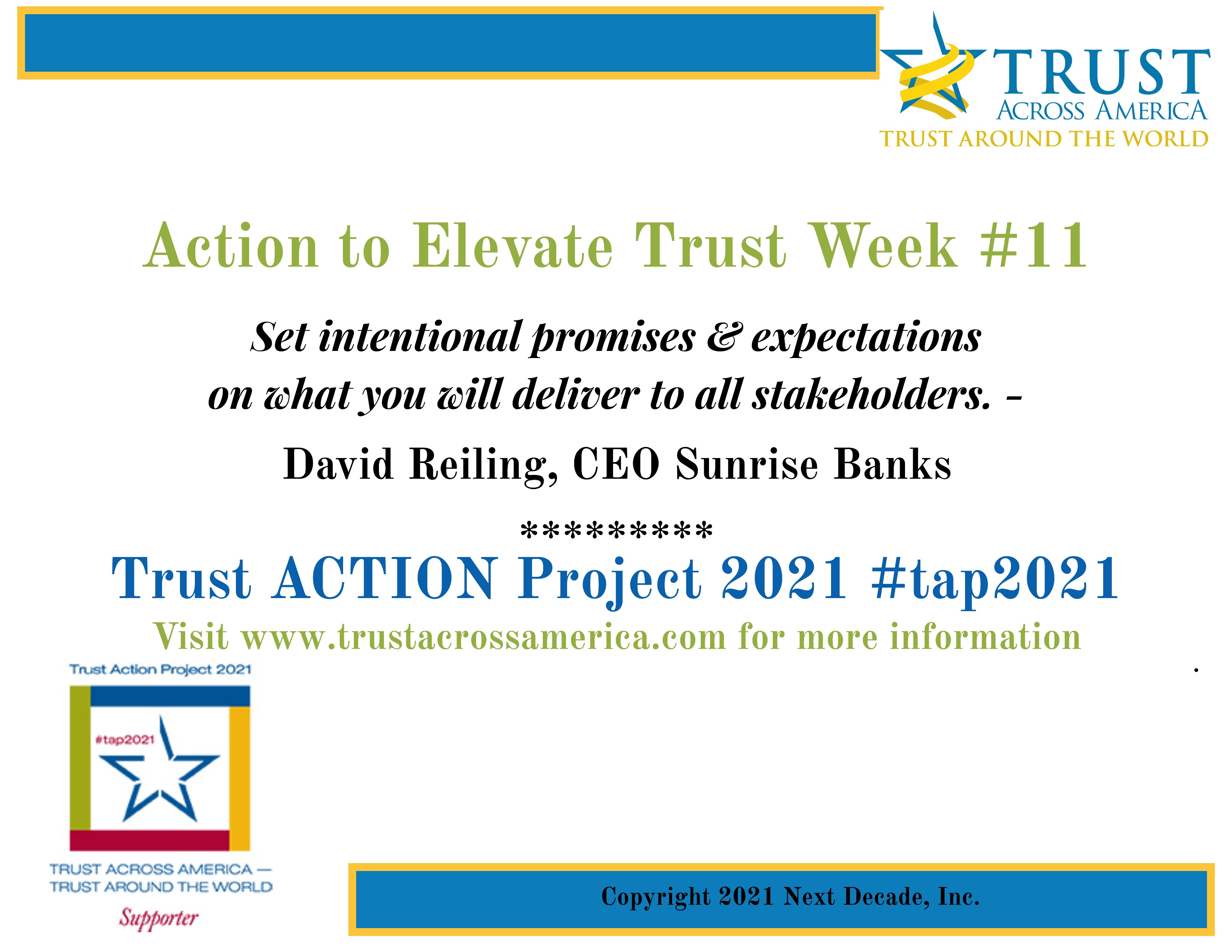
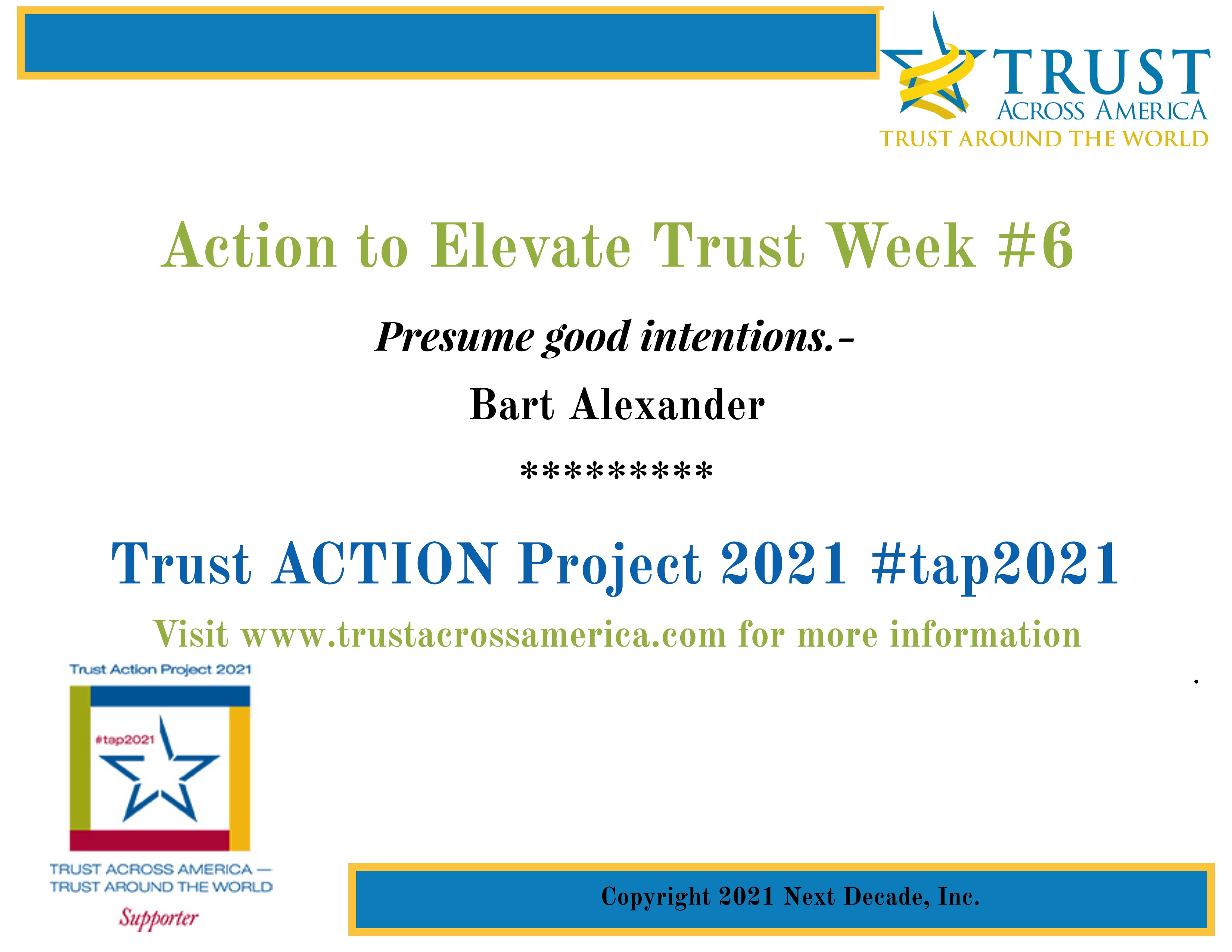
The Trust Action Project 2021 (#tap2021) Weekly Action is one of many Trust Alliance resources designed to help leaders, teams and organizations move from trust talk to ACTION in 2021 and beyond.


What behaviors do you think impact trust the most in teams and organizations? Our 1 minute/1 question AIM Workplace Diagnostic compares your response to 600 others.

Learn more about the Trust Action Project 2021 at this link.

Join our global Trust Alliance and participate in our programs.

What trust building ACTION would you suggest? Let us know.


, , , , , ,

Feb
07

The Trust Action Project 2021 (#tap2021) Weekly Action is one of many Trust Alliance resources designed to help leaders, teams and organizations move beyond trust talk to ACTION in 2021 and beyond.

Learn more about the Trust Action Project 2021 at this link.

How would you like to get involved? Let us know.


Copyright 2021, Next Decade, Inc.

, , , , , ,

Oct
15
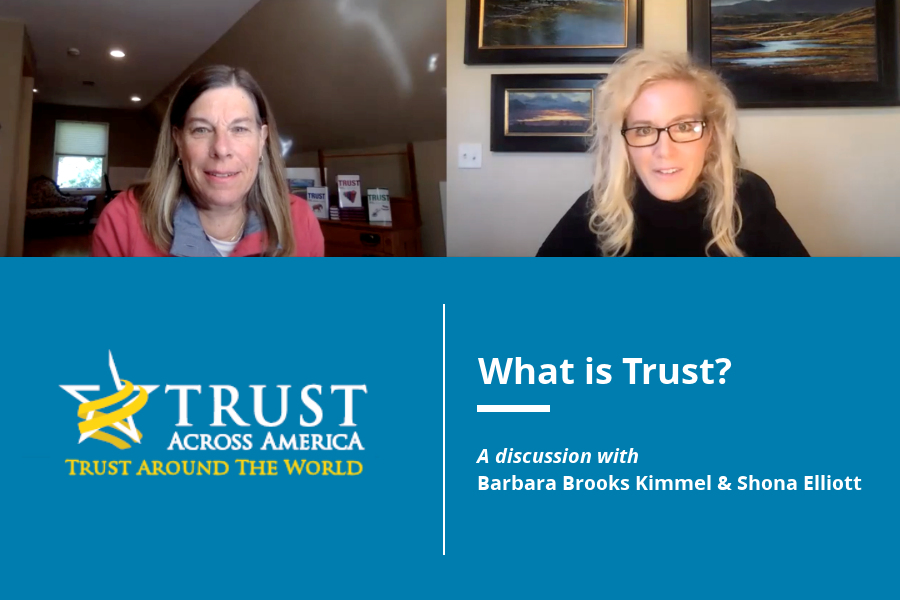
What is trust? 
Find out in this informal 5-minute Zoom discussion with Barbara Brooks Kimmel, Founder of Trust Across America-Trust Around the World and Shona Elliott.
Access the full 40-minute interview addressing the following questions and many more on our YouTube channel.
  • What is trust and how is it built in teams and organizations?
  • What are the major barriers leaders and teams face in building trust?
  • How can leaders proactively build trust?
  • How can they mend it after a crisis?
Barbara Brooks Kimmel is the founder of Trust Across America-Trust Around the World, whose mission is to help organizations build trust. Now in its 12th year, the program has developed two proprietary trust-evaluation tools, the latest is AIM Towards Trust. She also runs the world largest global Trust Alliance and is the editor of the award-winning TRUST INC. book series. Kimmel is a former consultant to McKinsey who has worked across multiple industries and with senior leadership. She holds a bachelor’s in international affairs from Lafayette College and an MBA from Baruch.

Copyright © 2020, Next Decade, Inc.

, , , , , , ,

Oct
06

Nominations are now open for Trust Across America-Trust Around the World’s 11th annual Top Thought Leaders in Trust.


Announcement of honorees will be made in January 2021 via TRUST! Magazine.

This unique program celebrates global professionals advancing the cause of trust.
How can you get involved?
Share this page link with others who may be qualified and interested.
Send along a suggestion of someone worthy of our consideration.
Nominate yourself or someone else (or have someone nominate you).
If you use our free resources, now is the time to show your support with a small donation. Visit our homepage and scroll down on the right.
Advertise in our upcoming annual honors announcement in January. Contact me for details.
Copyright 2020, Next Decade, Inc.

, , , ,

Aug
04

Having studied and observed trust building and trust busting behavior for over ten years, what’s crystal clear is that when people trust you, their confidence in you will increase, and they will be more inclined to do business with you.


LinkedIn claims to have more than 700 million users in 200 countries, and the platform can be a very powerful business tool, IF your goal is to build trust with your connections. The following are ten tips on how to do this.

  1. Begin with a clearly defined “ethics based” LinkedIn strategy, with the focus being your connections not you.
  2. Communicate authentically. Your values, beliefs and principles must align with your actions.
  3. Become the “go to” person in your area of expertise by publishing well-written original thought leadership pieces rather than announcing your next podcast or speaking engagement.
  4. Every post should represent added value to your readers or be solutions based.
  5. Share relevant, high quality content, even if it is from a competitor. Shine a spotlight on valuable material, regardless of who wrote it.
  6. Remain humble. Don’t tell your audience how “honored” or “humbled” you are while promoting your upcoming gig or your most recent award. That’s just insincere self-interest.
  7. Before publishing your next post answer this question: “Who cares (other than you and your mother)?”
  8. Engage your audience by asking them for input and feedback, and be sure to acknowledge every response.
  9. In this age of rapidly evolving social “activism” pick your photo captions carefully. For example, does your photo show a room full of men with no female presence? Does it just show you?
  10. You are the company you keep. Make sure the posts you are “liking” reflect positively on your values. (And instead of simply “liking” a post, leave a thoughtful comment.)

And now for a few surefire ways to bust trust really fast…

  1. Connecting with the sole purpose of selling something to your “prospect”
  2. Pretending in your initial connection request that you have something (undefined) in common.
  3. Immediately upon connecting, filling the recipient’s inbox with all sorts of “stuff” about how great you are.
  4. Having a profile that screams “amateur”: Words and phrases like guru, influencer, disruptor, rebel, world-renowned, life coach, Lion, Forbes and Inc. contributor… and best-selling author.
  5. Same goes for credentials- fake PhD’s and questionable experience are easy to spot and even easier to verify.
  6. Being a bragger about your latest upcoming “gig” and then having all your friends say “Congrats!”
  7. Ignoring comments, or better yet, deleting them if you disagree or think they might take the attention away from you.
  8. Trolling LinkedIn and inciting controversy.
  9. Showing zero interest in getting to know your new connections, even when they message you.
  10. Adding your LI connections to your mailing list without permission.

Having been an active LinkedIn member for many years, the balance is shifting away from thought leadership towards billboard advertising. If this is accurate, LinkedIn will surely (and quickly) lose its stature as a valuable business tool. In fact, I’ve spent the past several months deleting hundreds of self-promoting LinkedIn connections.

In summary, if the focus is simply “You,” maybe it’s time to rethink your LinkedIn strategy. Start by making “trust building” your core focus.

What other suggestions do you have for building trust on LinkedIn? Leave your comments.

Barbara Brooks Kimmel is the founder of Trust Across America-Trust Around the World, whose mission is to help organizations build trust. Now in its 12th year, the program has developed two proprietary trust-evaluation tools, the latest is AIM Towards Trust. She also runs the world largest global Trust Alliance and is the editor of the award-winning TRUST INC. book series. Kimmel is a former consultant to McKinsey who has worked across multiple industries and with senior leadership. She holds a bachelor’s in international affairs from Lafayette College and an MBA from Baruch.

Copyright 2020 Next Decade, Inc.

PS- Don’t forget to TAP into Trust!

For more information contact barbara@trustacrossamerica.com

, , , , , ,

May
05


Robert, thank you for participating in our 2020 Trust Insights series. What is your trust insight?

“Trust is not a message; it’s an outcome – and trust may not even be the real issue.” Robert Phillips


Can you expand a bit on this timely insight?

For way too long, “trust” has been hijacked by communications consultancies and strategy firms, who see/ position the trust “issue” and how to address it as a function of what the organisations says, rather than what it does. They sell strategies and programmes accordingly.  Together with reliance on some dodgy data, this leads to a bogus and corrosive narrative around trust: often creating a false sense of (global) crisis. This masks more profound issues and challenges and many cultural and political nuances.

Organisations would do better by focusing on their own behaviours and on the real issues (including the climate emergency and tech disruption) that lead to better outcomes for employees, customers and stakeholders. Furthermore, trustworthiness is a more relevant construct than “trust”. Trustworthiness is a function of Honesty + Competence + Reliability + Good. It is undermined by self-interest, especially where such self-interest is not transparently declared.


Can you provide a real life example of a trust “challenge” where your insight has been effectively applied.

The Global Responsible Tax Project curated by Jericho Chambers for KPMG, has been running since 2014. Based on organising principles of activism, participation, accountability and dissent, it now hosts a community of 1700 experts, built peer-to-peer, from the Global North to Global South and across the political spectrum – including corporate leaders; advisors; politicians and policy-makers; activists, NGOs and campaigners; academics and experts; media and the commentariart. This global coalition has worked together to develop new policy ideas and recommendations – leading to more trust between all parties and better policy outcomes for the common good. It’s starting point was that any solution to global tax problems were better served by addressing the purpose of tax, than communications and lobbying around the issues, and that no-one has all the answers. Tax is trust, write large – as this article brings to life.


Generally, do you think the global “trust” climate is improving or worsening? What actions are making it better or worse?

IpsosMORI long-term veracity data would suggest that trust remains in a chronic condition. The so-called “crisis of trust” masks a more profound crisis of leadership – in business and in politics. A failure to address the leadership issue will only prolong and never resolve the current condition.


Many claim we have a crisis of trust. Do you agree?

No, although a recognition of the chronic condition (see above) is important, as is a determination to do something about it.


Robert, thank you so much for your time and more importantly for your commitment to elevating organizational trust. What would you like our audience to know about you?

Robert has been at the forefront of the UK Public Relations industry for three decades. His expert area is the relationship between communications, leadership and trust. 

Robert’s 2015 book Trust Me, PR is Dead was heralded by Management Today as “a game-changer for the future of communications”. His often-outspoken views have been described as “essential for anyone who wants to influence and persuade in the mid-21st century”. Since 2014, Robert has helped build coalitions across business, government and civil society on subjects ranging from Responsible Tax to the Future of Work; Adult Social Care to the Future of Transport; Infrastructure and Housing to the Built Environment. Robert advocates new operating principles based on activism, accountability, co-production and dissent.

Robert is Founder of Jericho Chambers and Visiting Professor at Cass Business School, City, University of London. He was formerly CEO, Europe, Middle East & Africa for Edelman – the world’s largest Public Relations firm – and Global Chair of its Future Strategies & Public Engagement Group. He co-founded JCPR in 1987 – described by PR Week as “the seminal consumer brands consultancy of the Nineties and Noughties” – which he sold to Edelman in 2004. Two of Robert’s campaigns, for Wonderbra and PlayStation, were included in the Top 20 PR Campaigns of All Time.


Before you leave, Tap Into Trust and complete our 1 minute/1 question quiz. Find out how the level of trust in your workplace compares to hundreds of others. 

Have you reviewed how our workshops are helping teams and organizations just like yours elevate trust? Schedule an ONLINE webinar today.

Did you miss our previous 2020 Trust Insights? Access them at this link.

Contact us for more information on elevating trust on your team or in your organization or email me directly: barbara@trustacrossamerica.com

Copyright 2020, Next Decade, Inc.
, , , , , , , ,

Apr
14

Randy, thank you for participating in our 2020 Trust Insights series. What is your trust insight?

Trust doesn’t “just happen.” Randy Conley


Can you expand a bit on this important insight?

I’ve found that people think trust just sort-of evolves naturally over time, as if through some relationship osmosis. The thinking goes that the longer you know and interact with someone, the more you grow to trust them. That leaves the development of trust to happenstance, and for most people, they don’t think about trust in a relationship until it’s been broken.

A better way is to approach building trust with purpose and intention, and to realize that it’s a skill that can be developed. Trust is based on perceptions, and those perceptions are formed by the behaviors we use. If we behave in trustworthy ways, we’ll build trust with others. If we use behaviors that erode trust with others, then we won’t be trusted. It’s pretty straight-forward in that regard. If trust is based on perceptions, the challenge becomes whose perception is the correct one? That’s why it’s important to have a common definition of trust. Since trust can be so subjective, having a common understanding of what trust is and isn’t, allows organizational team members to be on the same page regarding how they can build trust in their relationships.


Can you provide a real life example of a trust “challenge” where your insight has been effectively applied.

I worked with the CEO of a mid-western steel manufacturer and his leadership team to define what trust means for their organization. Trust was one of their core values, but they didn’t have a common language or understanding about what that looked like in practice. They adopted our ABCD framework as their definition of trust, which allowed them to communicate to all employees that when they talk about trust, they are referring to team members demonstrating they are Able, Believeable, Connected, and Dependable, and knowing the behaviors that support each of those four elements.


Generally, do you think the global “trust” climate is improving or worsening? What actions are making it better or worse?

In a general sense, the climate of trust seems to be worsening. Society is becoming more polarized over political issues and the pace of change driven by technology is making it difficult for people to adapt. The seeds of distrust are planted when people begin to experience doubt about the intentions of others, which grows into an active suspicion, anxiety, fear, and ultimately self-protection. When people get to a state of self-protection, they are unwilling to take the risk of extending trust.

Many claim we have a crisis of trust. Do you agree?

Generally we do have a crisis of trust, but more specifically, we have a crisis of untrustworthy leaders. At its most fundamental level, trust is an interpersonal dynamic, and organizational leaders need to take more responsibility, and hold themselves to a higher level of accountability, to build and maintain trust with their stakeholders.


Randy, how has your membership in our Trust Alliance benefitted you professionally?

My involvement in the Trust Alliance has benefited me by learning from other experts in the field. Their wisdom has sharpened my thinking about trust and encouraged me to consider viewpoints I may not have considered had I not been part of this community. I, and hopefully other members, have mutually benefited from the support and encouragement we offer each other.


Randy, thank you so much for your time and more importantly for your commitment to elevating organizational trust. What would you like our audience to know about you?

Randy Conley is Vice President & Trust Practice Leader for The Ken Blanchard Companies. He is Blanchard’s subject matter expert in the field of trust, co-author of Blanchard’s Building Trust training program, and works with organizations around the globe helping them build trust in the workplace. Trust Across America has recognized Randy with a Lifetime Achievement Award as a Top Thought Leader in Trust and he is a founding member of the Trust Alliance. Inc.com named Randy a Top 100 Leadership Speaker & Thinker and American Management Association included him in their Leaders to Watch in 2015 list. He holds a Masters Degree in Executive Leadership from the University of San Diego.


Before you leave, Tap Into Trust and complete our 1 minute/1 question quiz. Find out how the level of trust in your workplace compares to hundreds of others. 

Have you reviewed how our workshops are helping teams and organizations just like yours elevate trust? Schedule an ONLINE webinar today.

Did you miss our previous 2020 Trust Insights? Access them at this link.

Contact us for more information on elevating trust on your team or in your organization or email me directly: barbara@trustacrossamerica.com

Copyright 2020, Next Decade, Inc.
, , , , , , ,