Archive

Posts Tagged ‘leadership’

Nov
08

Trust Across America-Trust Around the World (TAA-TAW) recently released its 10th anniversary report “Trust & Integrity in Corporate America 2018.” The report includes a list of America’s public companies that were named to TAA-TAW’s proprietary Trust & Integrity Index, requiring a score of at least 70/100 in our unique FACTS(R) Framework, now with 8 years of data. Understanding that no company is perfect, only 103 companies in the Russell 1000 qualified including several from Finance, proving once again that industry is not destiny.

A few names from the sector in alphabetical order: Bank of America, Blackrock, Capital One Financial, Goldman Sachs, Morgan Stanley and Voya Financial. Congratulations to the leadership of these companies on their success.

To access the complete report please visit the home page at www.trustacrossamerica.com 

Barbara Brooks Kimmel is an award-winning communications executive and the CEO and Cofounder of Trust Across America-Trust Around the World whose mission is to help organizations build trust. A former consultant to McKinsey and many Fortune 500 CEOs and their firms, Barbara also runs the world’s largest global Trust Alliance, and is the editor of the award-winning TRUST INC. book series and TRUST! Magazine. In 2012 she was named one of “25 Women who are Changing the World” by Good Business International, and in 2017 she became a Fellow of the Governance & Accountability Institute. Barbara holds a BA in International Affairs and an MBA. Don’t forget to TAP into Trust!

For more information contact barbara@trustacrossamerica.com
 

, , ,

Nov
06

(A condensed version of this article first appeared on The FCPA Blog)

Recently, the newly appointed CEO of Novartis, Vas Narasimhan, announced that he would be linking employee bonuses to ethics as part of a strategy to rebuild the company’s reputation. Specifics of the scoring system were not divulged. This raises some interesting questions in the trust, ethics and compliance community. Among them, is it ethical to pay people to act ethically or is it a form of bribery? Will these bonuses elevate ethical behavior? What is the minimum “acceptable” behavioral standard to receive a bonus? We asked Trust Across America’s 12-member Trust Council to weigh in. Some of their best answers from both a macro and micro perspective, are provided below.

Ethics is a Company Wide Issue

At Datron, we spend a lot of time in the FCPA world as over 90% of our business is conducted outside the US.  We find that ethics is a company wide issue that encompasses not only your employees but also any organization that represents us in the marketplace.  We have not taken the route of rewarding ethical behavior at the employee level.  We spend the money on training, both in the compliance area and in the “servant” leadership area to ensure that everyone understands the company mission, purpose and how our behaviors (values) are reflected in the work we do.  In our multi-cultural company with over 80 representatives around the world we take compliance to all entities that interface with our customers at any level.  This means that our annual FCPA training is required and annual anti-bribery statements are completed by both employees and our representative companies.  In addition we require all of our representatives to hold current Trace International certifications.  If these items are not completed as required we don’t do business with that organization and don’t let our employee interface with the customer.

In general I would recommend that leaders know what would work best for their organizations.  I personally would not take the approach Novartis has taken just because paying money for a required behavior is too much like a bribe and I believe it sends the wrong message to the organization.  It also says that it is ok to act unethically we just won’t provide you a bonus if you do.  I think requiring behavior in accordance with the company values is a better long-term solution.

I believe that a focus on culture, understanding why it is important for the organization to conduct itself in accordance with it’s core values and spending training dollars to ensure this each and every day is a better investment than providing an annual bonus award.  Art Barter

Influencing Human Behavior

This approach is a good idea for Novartis. We can’t change human nature—there will always be some unethical people. But we can influence human behavior. We influence human behavior through many means: education and training, personal examples and role models, good leadership, shared norms and values, rewards and punishments, and more. Good companies reward (or punish) employees with scoring systems for both achieving goals (results) and “how” those goals are achieved. Scoring a 1 on values and behavior at Novartis (1 = below expectations) makes an employee ineligible to receive a bonus and likely signals they may face demotion or termination. It is a realistic way to grab people’s attention that unethical behavior will no longer be tolerated at this firm. Bob Vanourek

Systematizing Ethical Practices

I applaud Novartis’ efforts to encourage and systematize ethical behavior. Behaving ethically should be the “ticket of admission” for even having a job, but many organizations don’t view it that way. Novartis is taking proactive steps to enforce consequences for salespeople who don’t meet expectations. Randy Conley

Innovation is Key

To determine the best ways to make progress on the trust, transparency and ethics road we have to innovate. To develop proven, repeatable and scalable strategies we all have to be bold enough to try. Novartis is trying. We don’t know the context or risk appetite they are working from so it is hard to objectively review their strategy. To innovate well we have to accept failure and partial successes, learn, pivot and go at it again. The fact that organizations are trying is, in my mind, the thing of value. They will engage in many critical conversations around this project and that dialogue with their employees, partners and board is priceless in the fight for ethics. Deb Krizmanich

Discussing Ethics

Ethical performance — good or bad — is an intrinsic aspect of organizational culture, While company value statements, codes of conduct and compliance training are essential components of an ethical culture, even more important is how organizations react to ethical dilemmas and lapses.  When discussions about ethics are taboo, and individuals are rewarded for unethically achieved results, the culture quickly adapts to this reality without regard to official policy.  In this respect, Novartis is on the right track by explicitly withholding rewards for employees who behave unethically.  Even more telling will be whether discussion of ethics is normalized and unethical behaviors consistently derail careers at the company. Barton Alexander

Payments for Behaving Ethically

There is something prima facie anti-ethical about paying people money to behave ethically. If you have to be paid to be ethical, you’re not. And by reducing ethics to behavioral inducements, the system devalues the ethicality of all actions, regardless of their objective desirability. This reduces ethics to the category of compliance and sales quotas. Charles H. Green

The Devil is in the Details 

Whether the Novartis plan is a good idea to resolve the ethical dry rot is debatable. The devil is in the details, but I would raise a caution flag.  Essentially they are saying that meeting expectations or being a role model for ethical behavior will earn employees extra pay, while not meeting expectations means you get no extra pay, and it could lead to termination. I also do not agree that bringing in Klaus Moosmayer from Siemens to be the ethics tsar is going to make up for poor leadership at the top. Bob Whipple

A further Internet search of the Novartis bonus “plan” revealed the following “anonymous” comment:

This has been in place for over two years. Probably just touting this in the news because of all the recent violations. Reps don’t get an additional bonus. They have money withheld from each bonus period and if their manager sees fit and gives them a good rating, they may or may not get all the money back. So Novartis actually takes money and holds it for a year. Some reps get back more but a lot will actually get back less. The kicker is, they have to still be employed to get that money and it’s only paid out once a year and it’s supposed to be about values and behaviors but it’s still tied to sales. 

The Trust Council jury is split with regard to the ethics of ethics bonuses. To be meaningful ethics and trust must remain a top-down strategy built from the inside out, and only then will they have a long-term impact on organizational reputation.

Trust Across America-Trust Around the World’s Trust Council is an invitation-only advisory group comprised of global business leaders and consultants from a broad cross section of industries and functions who are rotated through membership in our Trust Alliance. The Council serves for twelve months.

Barbara Brooks Kimmel is an award-winning communications executive and the CEO and Cofounder of Trust Across America-Trust Around the World whose mission is to help organizations build trust. A former consultant to McKinsey and many Fortune 500 CEOs and their firms, Barbara also runs the world’s largest global Trust Alliance, and is the editor of the award-winning TRUST INC. book series and TRUST! Magazine. In 2012 she was named one of “25 Women who are Changing the World” by Good Business International, and in 2017 she became a Fellow of the Governance & Accountability Institute. Barbara holds a BA in International Affairs and an MBA. Don’t forget to TAP into Trust!

For more information contact barbara@trustacrossamerica.com


, , , , , ,

Oct
17

October 17, 2018:

Trust Across America-Trust Around the World announces the Country Trust Index™, the first ranking of national trustworthiness 

Today, the Carnegie Council is celebrating its 5th annual Global Ethics Day, with organizations, including TAA-TAW joining forces to recognize ethics as an essential societal imperative.

What better day to announce our new rankings, honoring countries that are putting their citizens first.

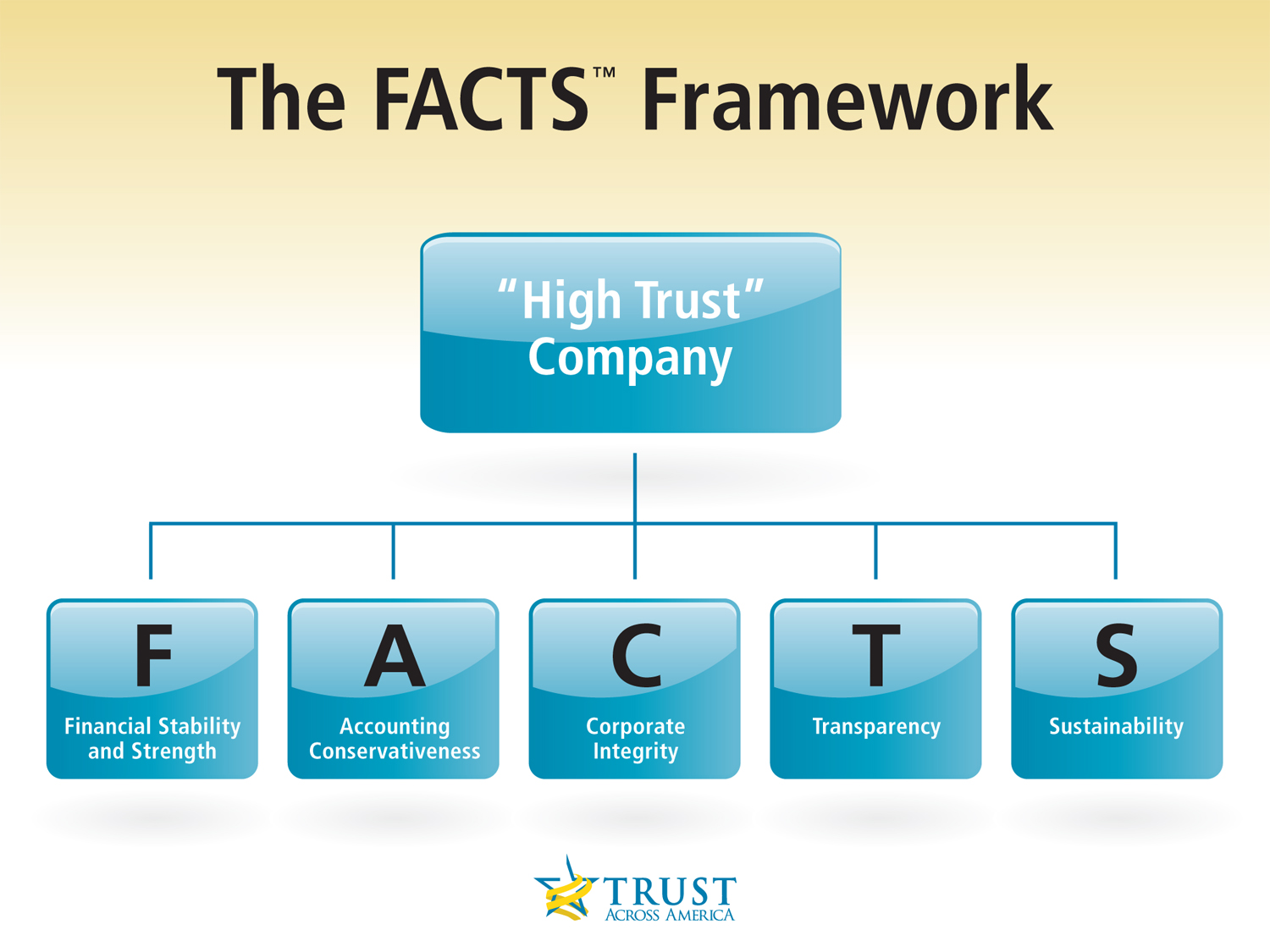
For almost ten years Trust Across America-Trust Around the World (TAA-TAW) has been tracking the trustworthiness of America’s largest public companies through a proprietary ranking framework called FACTS®. The Framework measures companies on five indicators of trust using independent third party data. Companies do not know they are being ranked, nor do they participate in our analysis. We recently published a 10th anniversary research report called “Trust & Integrity in Corporate America 2018” summarizing not only our findings, but those of over twenty major institutions who have been studying the impact of trust and ethics on business success.

Piggybacking on the release of our 2018 Trust Alliance Principles (TAP) this past spring TAA-TAW assembled a small global team of Trust Alliance members to advise on creating a similar ranking system for countries, using FACTS® as the framework, and aggregating the most current data from reputable third party providers. We identified fourteen indicators of societal trustworthiness including corruption, competition, reputation, sustainability, economic freedom, healthcare and women’s rights, to name just a few. The data was culled from global organizations including the World Bank, the Economist Intelligence Unit, The Heritage Foundation, The World Health Organization and Georgetown Institute for Women, Peace and Security. This comprehensive data collection and fact finding process allowed us to create the 2018 rankings. Almost seventy countries were analyzed with scores ranging from 66 to 1432. The lower the score, the higher the country ranked. Incomplete data precluded some countries from being included.

Switzerland wins by a landslide scoring a “66” and making the “top five” in ten of the fourteen categories. The country’s lowest score was in healthcare, ranking #20. After Switzerland, the scores took a relatively steep drop. The “Top 5” countries are listed in descending order:

  1. Switzerland
  2. Norway
  3. Denmark
  4. Canada
  5. Sweden

The United States ranks #20 with a total score of 369, and a relatively poor showing in reputation, healthcare and safety.

Some of the countries trailing the Country Trust Index™ rankings include:

Saudi Arabia, Brazil, India, China, Russia and Nigeria.

While this index may reveal some surprises, similar to our FACTS® Framework ranking of public companies, it’s purpose is to highlight the “best in breed.” Whether one is thinking about or discussing companies or countries, elevating trust and ethics is a win/win for all stakeholders.

To view the full rankings please visit www.trustacrossamerica.com and click on the “Research” tab or access directly at this link.

Barbara Brooks Kimmel is an award-winning communications executive and the CEO and Cofounder of Trust Across America-Trust Around the World whose mission is to help organizations build trust. A former consultant to McKinsey and many Fortune 500 CEOs and their firms, Barbara also runs the world’s largest global Trust Alliance, and is the editor of the award-winning TRUST INC. book series and TRUST! Magazine. In 2012 she was named one of “25 Women who are Changing the World” by Good Business International, and in 2017 she became a Fellow of the Governance & Accountability Institute. Barbara holds a BA in International Affairs and an MBA. Don’t forget to TAP into Trust!

For more information contact barbara@trustacrossamerica.com
Copyright (c) 2018, Next Decade, Inc. All rights reserved.

, , , , , , ,

Oct
13

If this confidential workplace culture survey were administered, how many of the following ten questions would you answer “yes?” 

(Take the survey below)

  1. Do you trust leadership?
  2. Are you very engaged at work?
  3. Do leaders have the “right” skills to build trust?
  4. Do the words of leadership match their actions?
  5. Does high organizational trust keep you at your job?
  6. Does your company behave ethically?
  7. Is the company culture highly aligned?
  8. Is innovation affected by the culture?
  9. Do you think a high trust culture is responsible for elevating the success of your company?
  10. Has leadership committed to elevating organizational trust?

No doubt these are some tough questions. And while most workplace surveys exclude them, imagine the valuable insights if they were included. And in fact, every one of these questions has been addressed in recent studies conducted by many leading organizations. These are just a few of the answers to the ten questions posed above.

  1. According to HBR.org and Zenger/Folkman, these two competencies were voted the most important for management positions. “Inspires and motivates others, displays high integrity and honesty.”
  2. According to Deloitte’s Millenial Survey 2018 only a minority of millenials believe businesses behave ethically.
  3. Gallup reports that only 46% of disengaged employees trust management.

Are you surprised by these findings? For the most part, trust in business has stagnated since we began tracking it ten years ago. In Trust Across America’s most recent 2018 study of the trustworthiness of America’s largest public companies only 103 companies in the Russell 1000 scored a 70% or above. The rest failed our test.

In celebration of our 10th anniversary helping organizations build trust, we spent the best part of the past three months assembling a research report called “Trust & Integrity in Corporate America 2018.” The (almost) 50-page report answers every question posed above, and many more. Studies from over 20 leading organizations, trust models addressing individuals, teams, leadership and organizations, highlights of our FACTS® Framework research and many other valuable tools are included.

Good measurement informs uncertain decision-making, and when an organization asks the right questions and measures what matters, leaders make better decisions. While corporate culture, core values, good citizenship, ethics, integrity and trust are commonly believed to be immeasurable intangibles or soft skills, research highlighted in our report points in the direction that these are not only false beliefs, but also that the benefits of an ethical culture far outweigh the costs. Yet most leaders continue to hold fast to the “soft skills” argument because neither they nor their Boards of Directors are thinking about them or reviewing the “right” data or inputs. Trust Across America tackled the “Board challenge” topic in the free spring 2018 issue of TRUST! Magazine.

It’s not uncommon for the following warning signs to be present in organizations when focus is on the wrong “tangibles” and the “soft skills” are misidentified.

  • The organizational culture is a mystery.
  • No clear “ownership” of ethical or trustworthy business practices or decision-making exists.
  • Discussions/training on ethics and trust rarely occur. When they do, they are lead by either the compliance or legal department and focus on rules, not integrity and trust since these attributes are voluntary and cannot be regulated.
  • Discussions of short-term gains and cost cutting dominate group meetings.
  • The pressure to perform is intense and the language used is very strong.
  • The Legal and Compliance departments are large and growing.
  • Ethical considerations/testing are not part of the hiring process and fear is widespread among employees.

Sound familiar? If so, leaders should be asking themselves a series of questions including the following. (Others are addressed in our recent report.)

SUCCESS: What role does trust play in ensuring a healthy culture ultimately impacting the success of your organization?

PERFORMANCE: How is trust tied to high performance, innovation, and sustainability in your organization?

COSTS: What are the costs/implications of not having a high level of trust in your organization?

BENEFITS: What are the payoffs of a trust-based organization for your stakeholders including your employees, customers, community and shareholders?

CULTURE: What values, principles or beliefs does your organization follow that are essential to building a foundation of trust?

What better time then now to start asking the “right” questions, collecting the “right” data and improving the culture for the benefit of all? Wouldn’t it be great if more organizations, including yours, could pass the test? What’s holding you back?

Take our survey here:

[powr-survey id=cc4e6af7_1539436598009]

Barbara Brooks Kimmel is an award-winning communications executive and the CEO and Cofounder of Trust Across America-Trust Around the World whose mission is to help organizations build trust. A former consultant to McKinsey and many Fortune 500 CEOs and their firms, Barbara also runs the world’s largest global Trust Alliance, and is the editor of the award-winning TRUST INC. book series and TRUST! Magazine. In 2012 she was named one of “25 Women who are Changing the World” by Good Business International, and in 2017 she became a Fellow of the Governance & Accountability Institute. Barbara holds a BA in International Affairs and an MBA. Don’t forget to TAP into Trust! For more information contact barbara@trustacrossamerica.com
 

, , , , , , , , , ,

Jul
23


By Barbara Brooks Kimmel, CEO & Co-founder Trust Across America


In the short-term “low trust” public companies can be very profitable. Corporate executives who “legally” cheat, steal, avoiding paying taxes, and stay just to the “right” of compliance may produce the profits that both their “old school” Board and short-term oriented shareholders crave, but these “business as usual” trust violations are not conducive to long-term business success. A growing number of companies are replacing the “stuck in the 80s leadership model” with proactive business executives who acknowledge that long-term success is built by embracing trust as both a strategic advantage and intentional business strategy. This translates to practicing “trust” on a daily basis by building a trustworthy and responsible corporate culture,  treating customers and suppliers “right”, by having superior products, great service, a well-configured Board, low employee turnover, and a high degree of innovation.

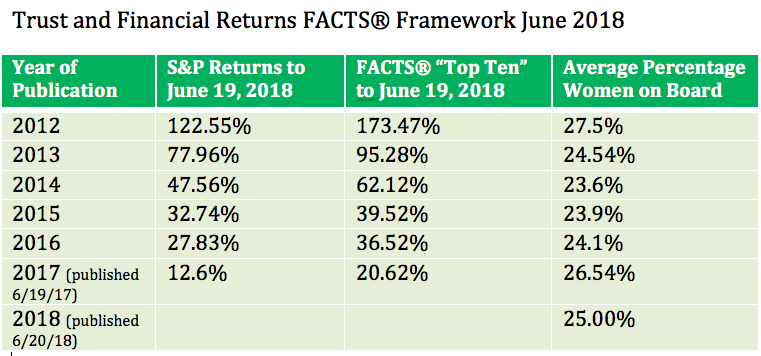
Now in its 9th year, our proprietary FACTS® Framework measures the trust “worthiness” of America’s largest public companies (over 2000). The following are some of the “fast facts” drawn from our larger study.

Chart #1 

Since 2012 Trust Across America has selected and publicly published an annual list of “Top Ten” Most Trustworthy Public Companies. Had you invested in those 10 companies on the day of publication, your portfolio would have significantly outperformed the S&P 500.

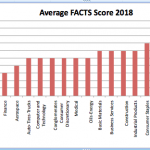
 Chart #2

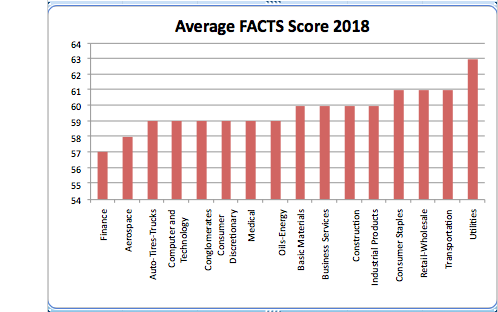
FACTS data can be sorted by sector and the following chart represents the sector rankings for the Russell 1000 for 2018. Please keep in mind that the Framework uses a broad 16-sector model provided by Zacks Investment Research. Others like S&P and Morningstar sometimes place companies in different sectors. For example, Zacks financial sector includes banks, insurance companies, REITS and brokerage firms, to name just a few. And it’s also important to remember that industry is NOT destiny.

The data can also rank companies within sectors, by market cap and headquarter location, to name just a few. We can also perform company comparisons.


Sector Rankings


Correlation Studies:

Trust Across America continues to run a series of ongoing correlation studies with other organizations and these are a few of our findings:

  • High correlation between our FACTS rankings and percentage of women on boards as reported by Catalyst.
  • High correlation between our FACTS rankings and Governance & Accountability Institute’s companies that voluntarily report on sustainability.
  • Low correlation between our FACTS rankings, Great Places to Work and Forbes Annual Ratings of Most Trustworthy Public Companies. (Forbes data providers employ a narrower “measure” of trust “worthiness” to compile their rankings.)

These studies and many others, confirm that the best companies are more responsible, and they dedicate the necessary resources for continuous improvement.

Our FACTS Framework and rankings are being licensed in a variety of formats. Read more about the Framework at this link.

Email Barbara@trustacrossamerica.com for more information.

Barbara Kimmel, CEO & Co-founder Trust Across America


Copyright© 2018, Next Decade, Inc.


, , , , , , , , , ,

Jul
18

Papa John’s is the latest to call for trust “reconstruction” from the inside out. A quick review of recent news headlines also mentions the EPA after Pruitt, Michigan State’s new athletic director, the Charlottesville police department, Samsung, and Wells Fargo, among others, all calling for trust rebuilding.

At first glance, the obvious recipients of that “first” phone call might be: PR firms and ad agencies, crisis management firms, risk experts, monitors or watchdogs, lawyers or compliance consultants. Yet every one of those choices will result in a “Band-Aid” fix, at best.

For an organization to rebuild trust, the first decision is not who gets the phone call, but who makes it. That first call must originate from the top, and be made to a professional firm with expertise in organizational trust. When that call is delegated to communications, legal or compliance, the chances of obtaining a long-term desired outcome are greatly reduced.

Trust building (and rebuilding) is an intentional holistic exercise. It can’t be pushed down the chain of command and it can only be fixed by the “right” people. Trust can’t be rebuilt with a press conference or an ad campaign, and it does take time.

These 12 Principles called TAP, were developed over the course of a year by a global group of ethics and trust professionals who comprise our Trust Alliance. They are currently available in 14 languages as free PDF downloads and serve as a great starting place and a clear roadmap to building and rebuilding trust. A variety of complimentary tools are also available on our website at trustacrossamerica.com and our Trust Alliance members may also be in a position to help.

Barbara Brooks Kimmel is the CEO and Cofounder of Trust Across America-Trust Around the World whose mission is to help organizations build trust. A former consultant to McKinsey and many Fortune 500 CEOs and their firms, Barbara also runs the world’s largest global Trust Alliance, and is the editor of the award winning TRUST INC. book series and TRUST! Magazine. In 2012 she was named one of “25 Women who are Changing the World” by Good Business International, and in 2017 she became a Fellow of the Governance & Accountability Institute. Barbara holds a BA in International Affairs and an MBA. For more information contact barbara@trustacrossamerica.com
Copyright (c) 2018, Next Decade, Inc.


, , , , , , , ,

May
30


Many models of (un)ethical decision making assume that people decide rationally and are in principle able to evaluate their decisions from a moral point of view. However, people might behave unethically without being aware of it. They are ethically blind.


As organizations are comprised of individuals, Ethical Blindness naturally extends into the workplace. Some business sectors appear to be more ethically blind than others, and this creates enormous enterprise risk. This chart shows the trustworthiness of the major sectors for the Russell 1000 companies based on Trust Across America’s FACTS(R) Framework.


Ethical blindness can be corrected if leaders choose to be “tuned in” to the warning signs described below:

  • The Board of Directors does not have established long-term policies or procedures in place to elevate ethical and trustworthy behavior with their internal and external stakeholders. For more information see the Spring Issue of Trust Magazine.
  • Leaders, unless they are ethically “aware” by nature, are not proactive about elevating trust or ethics as there is no mandate to do so. When a crisis occurs, the “fix” follows a common “external facing” script involving a costly and unnecessary PR campaign. Wells Fargo’s latest “building trust” television commercial provides a timely example. Meanwhile internally, it’s “business as usual.”
  • Discussions of short term gains and cost cutting dominate most group meetings. The pressure to perform is intense and the language used is very strong.
  • The Legal and Compliance departments are large and growing faster than any other function.
  • The organizational culture is a mystery. No clear “ownership” of ethical or trustworthy business practices or decision-making exist. Think “hot potato.”
  • Discussions/training on ethics and trust rarely occur and when they do, they are lead by either the compliance or legal department and focus on rules, not ethics and trust.
  • Ethical considerations/testing are not part of the hiring process and fear is widespread among employees.

Is Ethical Blindness at the organizational level fixable? Absolutely. But the first order of business requires leadership acknowledgement and commitment to elevating organizational trust and ethics.

These 12 Principles called TAP, were developed over the course of a year by a group of ethics and trust experts who comprise our Trust Alliance. They should serve as a great starting place for not only a discussion but a clear roadmap to eradicating Ethical Blindness. As a recent TAP commenter said:

An environment /culture that operates within this ethos sounds an awesome place to me , I would work there tomorrow if I knew where to look for it. 

Barbara Brooks Kimmel is the CEO and Cofounder of Trust Across America-Trust Around the World whose mission is to help organizations build trust. A former consultant to McKinsey and many Fortune 500 CEOs and their firms, Barbara also runs the world’s largest global Trust Alliance, and is the editor of the award winning TRUST INC. book series and TRUST! Magazine. In 2012 she was named one of “25 Women who are Changing the World” by Good Business International, and in 2017 she became a Fellow of the Governance & Accountability Institute. Barbara holds a BA in International Affairs and an MBA. For more information contact barbara@trustacrossamerica.com
Copyright (c) 2018, Next Decade, Inc.


, , , , , , , , , , ,

May
10


Elevating organizational trust becomes simple once leadership acknowledges the business case. That case has been made repeatedly by many organizations, including ours. Last month we introduced our TAP Principles through the Million Taps Campaign. Each of the 12 statements is designed to open the trust discussion among teams of any size in any organization. (TAP is currently available in 5 languages, with more being added.)

And if you are a leader who wants to build trust into your organization’s DNA, it all begins (and ends) with you. How many of these boxes can you check?

Start with an assessment of yourself:

  • Are you trustworthy?
  • Do you possess integrity, character and values?
  • Do you share those values with your family?
  • Do you instill them in your children?
  • Do you take your personal values to work?

Perform an organizational trust audit:

Consider your internal stakeholders:

Consider your external stakeholders:

  • Have you shared your vision and values in building a trustworthy organization?
  • Have you identified the outcome(s) you are seeking?
  • Have you defined your intentions for each of our stakeholder groups?
  • Have you made promises that you will keep?
  • Have you determined the steps you will take to fulfill these promises?

Elevating organizational trust is not difficult. It begins with awareness, acknowledgement of the long-term benefits and a daily commitment to do so.

Barbara Brooks Kimmel is the CEO and Cofounder of Trust Across America-Trust Around the World whose mission is to help organizations build trust. A former consultant to McKinsey and many Fortune 500 CEOs and their firms, Barbara also runs the world’s largest global Trust Alliance, and is the editor of the award winning TRUST INC. book series and TRUST! Magazine. In 2012 she was named one of “25 Women who are Changing the World” by Good Business International, and in 2017 she became a Fellow of the Governance & Accountability Institute. Barbara holds a BA in International Affairs and an MBA.

Copyright (c) 2018, Next Decade, Inc.

, , , , , , , , , , ,

Apr
26

Last week the spring issue of TRUST! Magazine was published by Trust Across America-Trust Around the World (TAA-TAW). This special 10th anniversary issue, coauthored with Bob Vanourek, a former corporate CEO and cofounder of Triple Crown Leadership is called Building Trustworthy Organizations: The Role of Good Governance. Having polled almost two dozen lead directors, Board members and governance experts, Bob and I asked three survey questions. The first two were:

What does/did the term “good corporate governance” mean to you? 

What are/were some of the key governance practices you find/found most useful to good corporate governance? 

The third question was:

What are some suggestions you have for improved corporate governance in the future? 

While the magazine contains literally dozens of responses and ideas, the following are ten recommendations regarding the Board in general:

  1. “Understanding and practicing good governance is not a skill set listed when looking for candidates to nominate for election to a board—it is important that good education is provided for new and current directors on the tenets of good governance which are publicized by the company.”
  2. “Good governance is enhanced with high levels of trust among board members, good communications between directors and senior management, a solid internal auditing function, and a reliance on competent outside counsel.”
  3. “Greater gender, ethnic, age and geographic diversity.”
  4. “Define ‘cognitive diversity’ and integrate it into the board search process.”
  5. “Fewer sitting CEOs as directors and limitations on how many boards their own CEO may sit on.”
  6. “A board that is deeply engaged with each other, the CEO, and leadership team.”
  7. “Yearly review by the board of recommendations from the various stakeholders for changes and additions to governance policies and procedures.”
  8. “Closer attention to ESG (Environmental, Social, Governance). In 2017, ExxonMobil faced a 62 per cent proxy vote for stronger climate change disclosure. Expect ESG to become a standard proxy concern for major shareholder groups.”
  9. “Ensuring a constructive, trustworthy tone at the top among board members and senior management, personally modeling appropriate behavior.”
  10. “Strive to lead in the spirit of trust to make things better now and for the future. Their goal is to leave the organization better than when they found it.”

Building trustworthy organizations is, indeed, an essential element of good corporate governance. As one of our wise respondents said of board members,

“As stewards, they strive to lead in the spirit of trust

to make things better now and for the future.

Their goal is to leave the organization

better than when they found it.”


Last week we also introduced TAP, our Trust Alliance Principles. They are available (in 5 languages) by tapping the button on our home page or to the right of this blog.

We hope these two new resources will help organizations build trust. That has remained the mission of TAA-TAW since it’s inception 10 years ago.

Barbara Brooks Kimmel is the CEO and Cofounder of Trust Across America-Trust Around the World whose mission is to help organizations build trust. A former consultant to McKinsey & Company, she also runs the world’s largest global Trust Alliance and is the editor of the award- winning TRUST INC. book series. In 2017 she was named a Fellow of the Governance & Accountability Institute, and in 2012 she was recognized as one of “25 Women who are Changing the World” by Good Business International. She holds a BA in International Affairs from Lafayette College and an MBA from Baruch at the City University of NY.

For more information visit our website at www.trustacrossamerica.com

or contact barbara@trustacrossamerica.com
Follow us on Twitter @BarbaraKimmel and @TapIntoTrust

You may also join our Constant Contact mailing list for updates on our progress.

Copyright (c) 2018, Next Decade, Inc.


, , , , , , , ,

Apr
24

Trust Across America-Trust Around the World continues to reach new milestones in its mission to help organizations build trust.

Last week we:

  1. Began our 10th anniversary celebration
  2. Released the spring issue of TRUST! Magazine whose title is Building Trustworthy Organizations: The Role of Good Governance
  3. Commenced a movement called TAP INTO TRUST, a set of global Principles to help organizations of any size elevate stakeholder trust.

None of these initiatives would have been possible without collaboration. As our Trust Alliance grows, our members are working side by side to elevate trust in organizations around the world.

If you lead an organization this document will provide the framework to begin the process of elevating trust.

Barbara Brooks Kimmel is the CEO and Cofounder of Trust Across America-Trust Around the World whose mission is to help organizations build trust. A former consultant to McKinsey & Company, she also runs the world’s largest global Trust Alliance and is the editor of the award- winning TRUST INC. book series. In 2017 she was named a Fellow of the Governance & Accountability Institute, and in 2012 she was recognized as one of “25 Women who are Changing the World” by Good Business International. She holds a BA in International Affairs from Lafayette College and an MBA from Baruch at the City University of NY.

For more information visit our website at www.trustacrossamerica.com

or contact barbara@trustacrossamerica.com
Follow us on Twitter @BarbaraKimmel and @TapIntoTrust

You may also join our Constant Contact mailing list for updates on our progress.

Copyright (c) 2018, Next Decade, Inc.

, , , , , , , , ,