Archive

Posts Tagged ‘leadership’

Apr
18

Organizations are being challenged to become more trustworthy. We often hear about trust in the context of rebuilding it after a crisis. But to maintain long-term, positive stakeholder relationships, leaders must make trust an intentional organizational imperative.

According to Barbara Kimmel, CEO and Cofounder of Trust Across America-Trust Around the World, “In order to effect change, trust can no longer be taken for granted. It is not a “soft skill” but rather a proactive intentional business strategy. Leaders must become trust “activists.” Those who choose to take a reactive approach are creating unnecessary enterprise risk.

How does the trust dialogue begin?

Prepared in collaboration with the Trust Alliance, the world’s largest group of trust scholars and practitioners, the Trust Alliance Principles (TAP) can be applied and practiced in any organization of any size. By adopting TAP, trust is built one person, team, project and organization at a time.

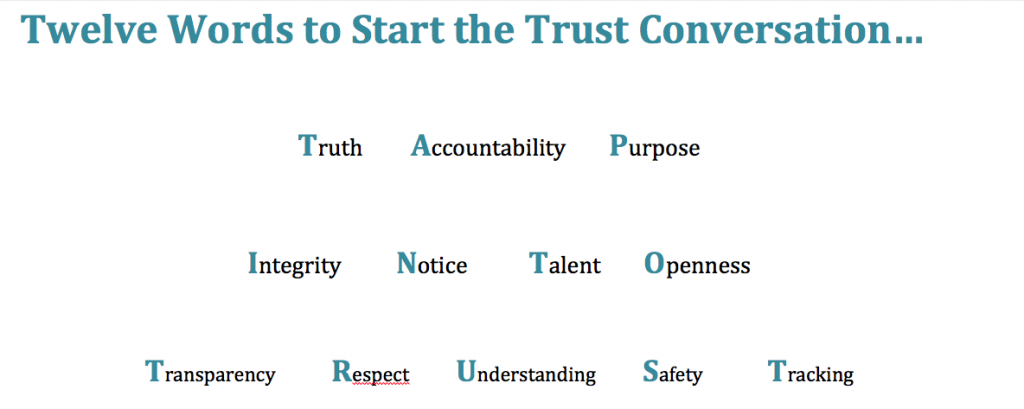
Take a look at these twelve words. They form the TAP INTO TRUST acronym. Each one of them can stand alone as a starting place to elevate trust in any size group in any organization anywhere.

For more information on TAP and the Principle behind each word, click on the “TAP INTO TRUST” blue button to the right.

Access our press release announcing this new program at this link.

Copyright 2018 Next Decade, Inc.

, , , , , , ,

Mar
25


Did Mark Zuckerberg breach trust? 

Facebook won the “breach of trust award” last week, but was it justified?

If you are a Facebook user, have you read the company’s data policy? Perhaps doing so would have elevated your awareness of the risks involved in using this popular social media tool.

Have you ever taken one of those free “silly” Facebook quizzes? Did you think they were being provided for your amusement, especially in cases where the user was paid to complete it?

A recent opinion piece in the Washington Post raised the following points?

Those who enter the ecosystem of social networking should not suddenly be shocked that information is being shared.

This transfer of data to a third party (Cambridge Analytica) broke Facebook’s internal policies. In 2015, Facebook found out, removed the app and demanded the data be destroyed. 

However, users must be realistic. Social media platforms are in business to share. Anyone who spends time browsing online will soon discover hidden sinews that connect each click.

The Washington Post article can be read at this link.

I’m all for elevating trust and the first to admit that this example has me thinking twice. Did Facebook make mistakes by not ensuring that the data was destroyed. Yes. But perhaps this was as much a learning experience for Mark Zuckerberg as it was for Facebook users. After all, no company (or leader) is perfect. Understanding the risks, maybe too much trust was extended by Facebook’s users.

Did Zuckerberg breach trust? What do you think?

Barbara Brooks Kimmel is the CEO and Cofounder of Trust Across America-Trust Around the World whose mission is to help organizations build trust. A former consultant to McKinsey & Company, she also runs the world’s largest global Trust Alliance and is the editor of the award- winning TRUST INC. book series. In 2017 she was named a Fellow of the Governance & Accountability Institute, and in 2012 she was recognized as one of “25 Women who are Changing the World” by Good Business International. She holds a BA in International Affairs from Lafayette College and an MBA from Baruch at the City University of NY.

For more information visit our website at www.trustacrossamerica.com

or contact barbara@trustacrossamerica.com

You may also join our Constant Contact mailing list for updates on our progress.

Copyright (c) 2018, Next Decade, Inc.
 

, , , ,

Mar
22


Our ongoing research at Trust Across America points in the direction that over time trustworthy public companies outperform their peers and the “markets.” This relatively small universe of well-governed companies goes beyond just meeting the needs of its shareholders to recognizing the importance of all its stakeholders.

Why Does this Make Sense?

Based on numerous studies high levels of trustworthiness are correlated with:

  • Ethical leadership
  • Happy employees and lower turnover
  • Faster decision-making
  • Higher innovation
  • Better community engagement
  • Decreased risk of corporate crisis

to name just a few benefits. And all of these factors impact the long-term bottom line.

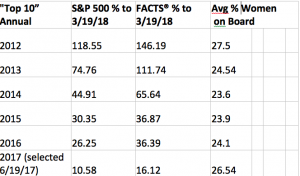
Every year since 2012 Trust Across America has publicly announced its “Top Ten Most Trustworthy Public Companies” via an annual article on our blog. The following table displays the current cumulative returns of the companies selected each year vs. the S&P 500 since the date of the blog publication.

FACTS(R) Framework Annual Returns “Top Ten”


Note: FANG companies have never appeared in any of the “Top 10” selections.


How are these Companies Chosen?

In 2010 Trust Across America introduced the FACTS® Framework, a comprehensive unbiased barometer of the trustworthiness of America’s largest 2000 US public companies. The Framework (based on 5 equally weighted indicators) identifies companies whose leadership has intentionally chosen to govern in a manner that goes beyond doing just what is legal to choosing what is right in meeting all stakeholder needs. Now in its 8th year the FACTS® Framework is the most comprehensive and data driven ongoing study on this subject. We analyze companies quarterly and rank order showing trends by company, sector and market capitalization.

Whether one calls this great culture, high integrity “ESG,” or simply trust, the business case has been made. Leaders who choose to ignore trust are setting themselves up for not only a crisis, but a sudden decline in their stock value. Just ask Mark Zuckerberg.

Barbara Brooks Kimmel is the CEO and Cofounder of Trust Across America-Trust Around the World whose mission is to help organizations build trust. A former consultant to McKinsey & Company, she also runs the world’s largest global Trust Alliance and is the editor of the award- winning TRUST INC. book series. In 2017 she was named a Fellow of the Governance & Accountability Institute, and in 2012 she was recognized as one of “25 Women who are Changing the World” by Good Business International. She holds a BA in International Affairs from Lafayette College and an MBA from Baruch at the City University of NY.

For more information visit our website at www.trustacrossamerica.com

or contact barbara@trustacrossamerica.com

You may also join our Constant Contact mailing list for updates on our progress.

Copyright (c) 2018, Next Decade, Inc.
, , , , , ,

Feb
27


The other day I was speaking with someone who is not familiar with my professional work. He told me that his company is asking all employees to complete an anonymous “satisfaction” survey, and now blasting email reminders to those who have not yet filled out the online questionnaire. I asked what was holding him back. His response… “I doubt it’s anonymous and I will NOT be honest for fear of losing my job. My colleagues are also nervous about how to handle this.”

I know a bit about this company since two generations of my family have used their services and watched their evolution from a “one man shop” in the 1960s. At one time my dad and the founder of the company used to “talk shop” in our garage. Fast-forward and the company is now a 50+ year-old family business in residential and commercial services with well over 100 employees. They have been acquiring competitors at a fast pace and had their “best year” in 2017. The founder is now retired and management (primarily family and family of family) has all worked their way up through the trenches.

From my customer perspective:

  • Main office customer service is declining, with an emphasis on charges, not service
  • The skill level of technicians is no longer consistent
  • Up selling during service visits is increasing
  • Prices have skyrocketed

Back to my conversation with the employee… I asked whether his manager had ever attempted to obtain the same “survey” information through any other means like face-to-face discussions, team conversations, workshops or professional development? He laughed and replied that such actions would surely result in fistfights, so “No.”

I pressed further. Why would fights break out? He responded with a list of reasons:

  1. Management plays favorites
  2. Demands on employees are unrealistic and uneven
  3. Politics runs rampant
  4. Lots of jerks in the room
  5. Nobody trusts anybody else

So what’s really happening here? Without any additional information I would point to lack of competent leadership, which has resulted in a culture of distrust. It’s one thing to run a small “mom and pop shop” and quite another to manage several acquisitions, rapid growth and on boarding of large numbers of new employees. Just because a person may be “family” doesn’t mean they are “cut out of the leadership cloth.”

Employee satisfaction surveys will do little to help this company except perhaps bolster management egos, and maybe provide some advertising “bragging rights” if all the employees exaggerate their responses for fear of job loss.

I wish this were a unique story. Is it?

Am I correct in my assessment of the “real” problem?

What should be done differently?

Barbara Brooks Kimmel is the CEO and Cofounder of Trust Across America-Trust Around the World whose mission is to help organizations build trust. A former consultant to McKinsey & Co., she also runs the world’s largest global Trust Alliance and is the editor of the award- winning TRUST INC. book series. In 2017 she was named a Fellow of the Governance & Accountability Institute, and in 2012 she was recognized as one of “25 Women who are Changing the World” by Good Business International. She holds a BA in International Affairs from Lafayette College and an MBA from Baruch at the City University of NY.

Join our Constant Contact mailing list for updates on our progress.

Contact me for more information.

Purchase our books at this link

Copyright 2018 Next Decade, Inc.


, , , ,

Feb
20

Trust is not a soft skill, nor should it be taken for granted. It is a tangible asset that impacts the bottom line.

Last week’s blog post discussed the various ways that low trust can kill an organization. So how can trust be elevated? We asked our Trust Alliance members to weigh in and the following are some “best practices” for building organizational trust.

  • First identify what builds trust and what breaks trust. Bob Vanourek
  • Agree on core values, then practice and reinforce them daily. Barbara Brooks Kimmel
  • Build cultures of commitment vs. compliance where choices are guided by values, not policies. Mark Fernandes
  • Work tirelessly to dispel the illusion that trust is a soft skill. Doug Conant
  • Be a role model. Charlie Green
  • Be inclusive in your decision-making process. Nadine Hack
  • Set intentional promises and expectations on what you will deliver to all stakeholders. David Reiling
  • Go public when expressing gratitude; go private when expressing disappointment. Holly Latty-Mann
  • Presume good intentions. Bart Alexander
  • In every interaction with every person, ask yourself “What can I do in this moment to strengthen the trust between us?” Jim Kouzes

Our growing global Trust Alliance is working to build tools to help organizations of all sizes and shapes build trust. What’s stopping you from joining?

Barbara Brooks Kimmel is the CEO and Cofounder of Trust Across America-Trust Around the World whose mission is to help organizations build trust. A former consultant to McKinsey & Co., she also runs the world’s largest global Trust Alliance and is the editor of the award- winning TRUST INC. book series. In 2017 she was named a Fellow of the Governance & Accountability Institute, and in 2012 she was recognized as one of “25 Women who are Changing the World” by Good Business International. She holds a BA in International Affairs from Lafayette College and an MBA from Baruch at the City University of NY.

Join our Constant Contact mailing list for updates on our progress.

Copyright 2018 Next Decade, Inc.


, , , , , , ,

Feb
13


Did you know that the average lifespan of a public company is now less than 20 years, down from 60 years in the 1950s? While some might argue that disruptive technology is to blame, that’s a smoke screen for the real culprit. After all, high trust companies are great innovators.

Today’s pervasive low trust business environment might be the #1 risk to every company. Without trust as a foundation, the chances for long-term survival are slim to none, and crises are a sure bet.

While trust holds the key to long-term success  it remains the single most overlooked, yet one of the simplest business strategies to implement.

How many of these low trust warning signs are present in your organization?

  1. Trust is taken for granted and viewed as a soft skill. It is never discussed.
  2. There is no Chief Trust Officer or keeper of the culture. Instead, the Chief Compliance Officer wields the “big stick” and remains the laughing stock of the employees.
  3. corporate credo or core values are nonexistent, or the one in place is no more than Kumbaya “words” on the corporate website.
  4. Strategies to elevate organizational trust have never been discussed let alone defined, shared or agreed upon.
  5. Leadership is focused on survival and short-term profitability. In fact, compensation is tied to quarterly earnings.
  6. The leadership team lacks leadership skills and never speaks publicly without “legal” sign off. (Great college lacrosse players don’t necessarily make trustworthy leaders.)
  7. There is not a single woman in sight on the executive leadership team.
  8. A well-defined hiring strategy has not been implemented resulting in cultural misalignment, confused and non engaged employees.
  9. Employee turnover is high but no one asks “Why?”
  10. Board members are “Yes men” for the CEO, and “Yes” they are all men.

How many of these trust “fails” do you see on a daily basis? What’s your guess on the longevity of your business?

Want to learn more about building organizational trust? Our website provides an endless number of tools and resources for elevating organizational trust. Many of them are free. Read a book, join our Trust Alliance, find an hour to discuss a Case Study, read the Trust Across America blog.

Barbara Brooks Kimmel is the CEO and Cofounder of Trust Across America-Trust Around the World whose mission is to help organizations build trust. She also runs the world’s largest global Trust Alliance and is the editor of the award- winning TRUST INC. book series. In 2017 she was named a Fellow of the Governance & Accountability Institute, and in 2012 she was recognized as one of “25 Women who are Changing the World” by Good Business International. She holds a BA in International Affairs from Lafayette College and an MBA from Baruch at the City University of NY.

Join our Constant Contact mailing list for updates on our progress.

Copyright 2018 Next Decade, Inc.


, , , , , , , , ,

Feb
06

“Professors are reacting to the news, but they are also responding to calls from students for classes that deal with ethics. In recent years, students have said ethical issues, not finances, are a business’s most important responsibility, according to a survey of business school students worldwide conducted by a United Nations group and Macquarie University in Australia.”

This is a quote from a December NY Times article addressing the growing demand for teaching ethics in business schools.

Trust Across America-Trust Around the World is pleased to announce the launch of a free case study library offering examples of “real life” business trust & ethics challenges and successes. The one-page “Trustlets” are designed to encourage discussion in both an academic and business setting and include instructions for facilitators. Written by members of the Trust Alliance, our Top Thought Leaders in Trust and academics from around the world, Trustlets will provide free and easy access to content that will be regularly updated as new cases are submitted. Each case will focus on a specific business challenge and covering a broad range of trust and ethics related topics. Both schools and businesses can feel free to access the library to meet the growing interest recently highlighted in the NY Times.

This latest initiative closely aligns with Trust Across America’s mission of helping organizations build trust. Trustlets provide a new tool that future business leaders can utilize to gain a “real life” understanding of how elevating trust & ethics are both a necessary (and expected) component of good business practices.

Trust Across America-Trust Around the World is celebrating it’s 10th anniversary. We welcome all our readers to join in our celebration as we roll out many new programs during the year ahead.

Trust Across America-Trust Around the World is a program of Next Decade, Inc., an award-winning communications firm that has been unraveling and simplifying complex subjects for over 20 years. TAA-TAW helps organizations build trust through an abundance of resources and ever expanding tools, many offered at no cost. It also provides its proprietary FACTS(R) Framework to help public companies improve their trustworthy practices, and showcases individuals and organizations exhibiting high levels of trust and integrity.

For more information contact Barbara Brooks Kimmel at barbara@trustacrossamerica.com

Copyright (c) 2018, Next Decade, Inc.
 

, , , , , , , , ,

Jan
29


Trust Across America-Trust Around the World (TAA-TAW), global leaders in organizational trust honors its 2018 Top Thought Leaders in Trust. The awards program, now in its 8th year, celebrates professionals who are transforming the way organizations do business.

While a growing number of global “top” lists and awards are published every year, no others address organizational trust, perhaps because the word “trust” itself presents a definitional challenge. For almost 10 years TAA-TAW has been working with a team of cross-functional professionals to study, define and quantify organizational trust, integrity and trustworthiness.

According to Barbara Kimmel, CEO and Cofounder, “The publication of this year’s honors comes shortly before the official commencement of our 10th year anniversary celebration. In collaboration with global members of our Trust Alliance, we will be creating several new programs and tools to help organizations build trust.”

This year we recognize 91 global professionals from a broad functional base including integrity and trust, leadership, culture, compliance and ethics, reputation and risk management, governance, CSR, communications, employee engagement, sales and customer service. Approximately 27% of our 2018 honorees are women.

We are presenting our honorees in five categories:

2018 Lifetime Achievement Award Winners (8)

Lifetime Achievement Award Winners 2015-2017 (29)

Multi-year honorees (22)

CEOs of Public Companies (7)

Newcomers (25)

This year we are honoring eight professionals with a Lifetime Achievement Award. These deserving individuals have maintained Top Thought Leader status for five years. We congratulate all of our honorees whose work is shining a spotlight on the importance of trust and providing a roadmap for others to follow. They inspire organizations to look more closely at their higher societal purpose…to create greater value for, and trust from all of their stakeholders, and acknowledge that trust is a “hard currency” with “real” returns.

The 2018 Lifetime Honorees can be accessed at this link, while complete details including our methodology, judges, award winners, articles and additional trust resources can be found in the free digital Winter 2018 issue of TRUST! Magazine.

Trust Across America-Trust Around the World™ is a program of Next Decade, Inc., an award-winning communications firm that has been unraveling and simplifying complex subjects for over 20 years. TAA-TAW helps organizations build trust through an abundance of resources and ever expanding tools. It also provides its proprietary FACTS(R) Framework to help public companies improve their trustworthy practices, and showcases individuals and organizations exhibiting high levels of trust and integrity.

For more information contact Barbara Brooks Kimmel at barbara@trustacrossamerica.com

Copyright (c) 2018, Next Decade, Inc.
 

, , , , , ,

Jan
15


Without generosity elevating organizational trust is not attainable, and the resulting low trust level is very expensive. Think about that. If leaders do not give their time or expertise to their stakeholders, they should not expect more than minimal progress in any facet of their enterprise. Unfortunately, low generosity is the “norm” not the exception in the *age of diminishing trust, and financial philanthropy is not a sufficient substitute.

As the CEO of Trust Across America, and in celebration of our 10th anniversary, I am pledging to freely give two hours per week of my time to share the organizational trust expertise I have developed over this ten-year period.

Email me at barbara@trustacrossamerica.com , message me on LinkedIn or post your question right here. What organizational trust challenge are you trying to solve? Let me know. I will respond directly or, if I do not feel qualified to answer, I will pass your inquiry to the best qualified member of our Trust Alliance. There is no cost to you whatsoever. It is simply Trust Across America’s way of positively impacting the trust challenges our global society currently faces.

*Need further proof?

  • Employee engagement continues to fall to 32% on 8/6/17
  • Organizations with low employee engagement scores saw 18% lower productivity, 16% lower profitability, 37% lower job growth, and 65% lower share price over time. (Source: Queens School of Business and by the Gallup)
  • Innovation stalls
  • 86% of corporate executives, employees and educators say that ineffective communications is a big reason for failures in the workplace. (Source: Salesforce)

Maybe you can find a way to participate in The Year of Living Generously. It starts today. How much time will you spare to share your expertise and elevate trust?

Barbara Brooks Kimmel is the CEO and Cofounder of Trust Across America-Trust Around the World whose mission is to help organizations build trust. She also runs the world’s largest global Trust Alliance and is the editor of the award- winning TRUST INC. book series. In 2017 she was named a Fellow of the Governance & Accountability Institute, and in 2012 she was recognized as one of “25 Women who are Changing the World” by Good Business International. She holds a BA in International Affairs from Lafayette College and an MBA from Baruch at the City University of NY.

For more information visit our website at www.trustacrossamerica.com

You may also join our Constant Contact mailing list for updates on our progress.

Copyright (c) 2018, Next Decade, Inc.

 

, , , , , , ,

Jan
06


Ten years of ongoing research on organizational trustworthiness has Trust Across America concluding that well-governed companies are less prone to crisis and more profitable over the long term.

One need not look beyond Uber to the fallout of a corporate governance failure. Yet, as a business leader, my definition of “well governed” may not necessarily align with yours.

If your current or past experience includes Independent Lead Directorship, Board Chair or CEO (either active or retired), would you kindly take a few minutes to respond in writing, with short answers, to the following questions?

  • What does/did the term “good corporate governance” mean to you?
  • What are/were some of the key governance practices you find/found most useful to good corporate governance?
  • What are some suggestions you have for improved corporate governance in the future?

We hope to receive 50 responses to be published in a special upcoming governance issue of TRUST! Magazine as well as in a series of articles.

If you do not want to be identified, that works too, but please respond with the following information.

Name:

Title:

Company:

Can we publish your response with your name and title?


Please reply directly to me: Barbara@trustacrossamerica.com. We are hoping to collect your response no later than February 1, 2018, in time for our publication. Thank you in advance for your participation.

Barbara Brooks Kimmel
CEO and Cofounder

, , , , , , ,